

| Le Petit Parisien 17 février 1924 |
|
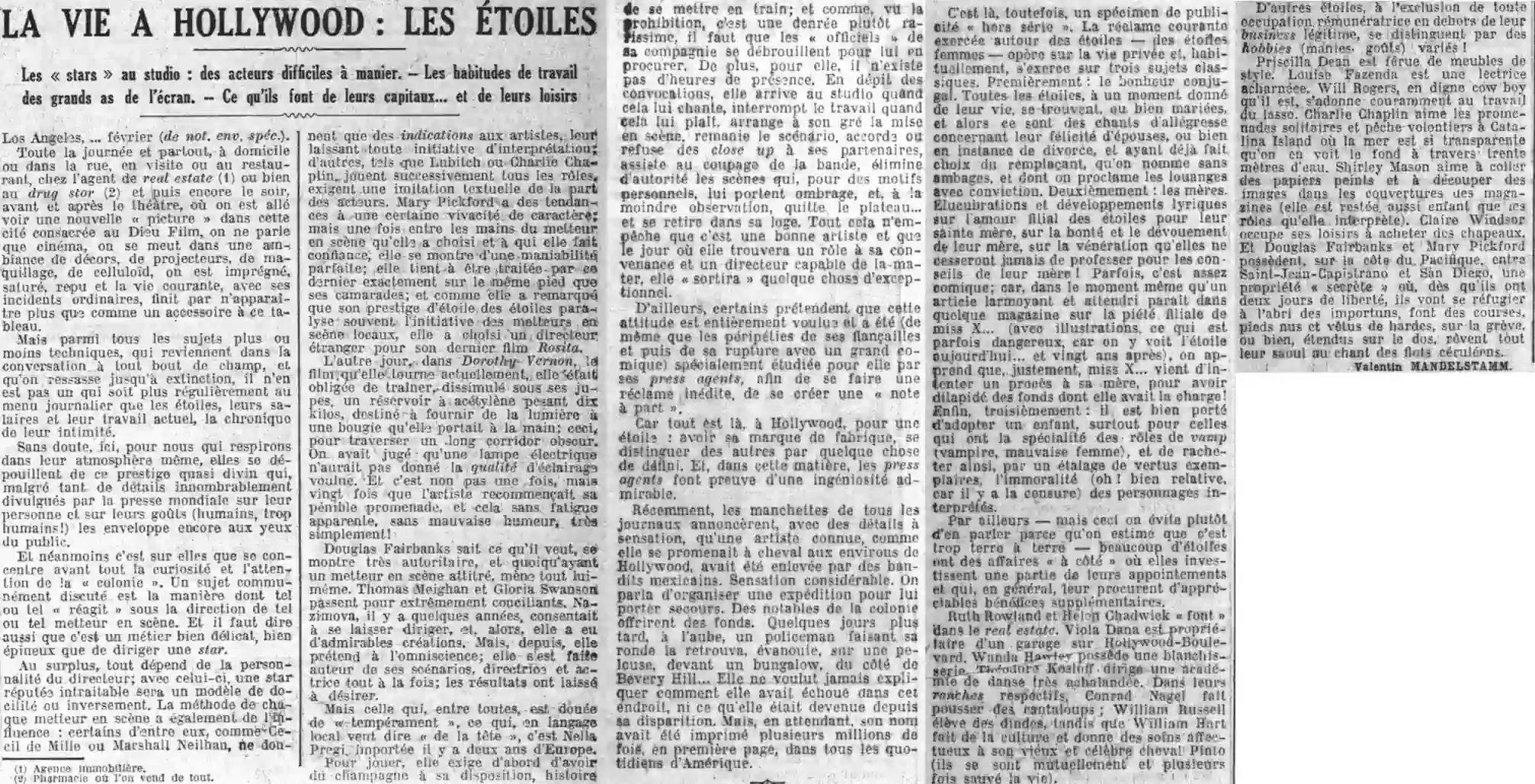
Los Angeles,... February (noted approx. spec.).
All day and everywhere, at home or in the street, visiting or at a restaurant, at the real estate agent's (1) or at the drug store (2) and then again in the evening, before and after the theater, where we went to see a new “picture” in this city dedicated to God Film, we only talk about cinema, we move in an atmosphere of sets, projectors, makeup, celluloid, we are impregnated, saturated, satisfied and the everyday life, with its ordinary incidents, ends up appearing only as an accessory to this picture.
But among all the more or less technical subjects, which come up in conversation all the time, and which we rehash until extinction, there is not one which is more regularly on the daily menu than the stars, their salaries and their current work, the chronicle of their intimacy.
No doubt, here, for us who breathe. in their very atmosphere, they strip themselves of this almost divine prestige which, despite so many details divulged innumerably by the world press about their person and their tastes (human, all too human!) still envelops them in the eyes of the public. And nevertheless it is on them that the curiosity and attention of the “colony” is focused above all. A commonly discussed topic is the way in which this or that “reacts” under the direction of this or that director. And it must also be said that it is a very delicate, very thorny job to direct a star. Furthermore, everything depends on the personality of the director; with this, a star deemed intractable will be a model of docility or vice versa. The method of each director also has an influence. Some of them, like Cecil de Mille or Marshall Neilhan, only give indications to the artists, leaving them with any interpretive initiative; others, such as Lubitch or Charlie Chaplin, play all the roles successively, requiring textual imitation from the actors. Mary Pickford has tendencies towards a certain liveliness of character; but once in the hands of the director she has chosen and in whom she trusts, she shows herself to be perfectly manageable; she wants to be treated by the latter on exactly the same footing as her comrades; and as she noticed that her prestige as a star of stars often paralyzes the initiative of local directors, she chose a foreign director for her latest film Rosita. The other day, in Dorothy Vernon, the film she is currently filming, she was obliged to drag around, hidden under her skirts, an acetylene tank weighing ten kilos, intended to provide light for a candle which she carried at home. the hand; this, to cross a long dark corridor. It was judged that an electric lamp would not have provided the desired quality of lighting. And it was not once, but twenty times that the artist began his painful walk again, and this without apparent fatigue, without bad mood, very simply! Douglas Fairbanks knows what he wants, is very authoritarian, and although he has an assigned director, directs everything himself. Thomas Meighan and Gloria Swanson are considered extremely accommodating. Nazimova, a few years ago, agreed to let herself be directed, and then she had some admirable creations. But, since then, she has claimed omniscience; she became author of her screenplays, director and actress all at the same time; the results left something to be desired. But the one who, above all, is gifted with temperament”, which in local language means “of the head”, is Nella Pregi, imported two years ago from Europe. To play, she first requires having champagne at her disposal, just to get started; and since, given Prohibition, it is a rather rare commodity, the “officials” of his company have to manage to get him some. Furthermore, for her, there are no hours of attendance. Despite summons, she arrives at the studio when she wants, interrupts work when she pleases, arranges the staging as she wishes, reworks the script, grants or refuses close-ups to her partners, assists in the cutting of the band, authoritatively eliminates scenes which, for personal reasons, offend him, and, at the slightest observation, leaves the stage... and retires to his dressing room. All this does not prevent the fact that she is a good artist and that the day she finds a role that suits her and a director capable of controlling her, she will “release” something exceptional.
Moreover, some claim that this attitude is entirely intentional and was (like the adventures of her engagement and then her breakup with a great comedian) specially studied for her by her press agents, in order to make an unprecedented claim. , to create a “separate note”. Because everything is there, in Hollywood, for a star to have its trademark, to distinguish itself from others by something defined. And, in this matter, press agents demonstrate admirable ingenuity. Recently, the headlines of all the newspapers announced, in sensational detail, that a well-known artist, while riding on horseback near Hollywood, had been kidnapped by Mexican bandits. Considerable feeling. There was talk of organizing an expedition to help him. Notables of the colony offered funds. A few days later, at dawn, a policeman making his rounds found her, unconscious, on a lawn, in front of a bungalow, near Bevery Hill... She never wanted to explain how she had ended up in this place, nor what she had become since her disappearance. But, in the meantime, his name had been printed several million times, on the front page, in every daily newspaper in America. This is, however, a unique specimen of advertising.” The current advertising exercised around the stars of women stars operates on the private life and, usually, is exercised on three classic subjects. Firstly, marital happiness. All stars, at a given moment in their lives, find themselves either married, and then there are songs of joy concerning their bliss as wives, or in the process of divorce, and having already chosen a replacement, which we name without ambiguity, and whose praises we proclaim with conviction. Second: mothers. Elucubrations and lyrical developments on the filial love of the stars for their holy mother, on the goodness and devotion of their mother, on the veneration that they will never cease to profess for their mother's advice! Sometimes it's quite comical; because, at the very moment that a tearful and touching article appears in some magazine on the filial piety of Miss X... (with illustrations, which is sometimes dangerous, because we see the star there today... and twenty years later), we learn that, in fact, Miss X... has just sued her mother for having squandered funds she was responsible for! Finally, thirdly: it is good practice to adopt a child, especially for those who specialize in vamp roles (vampire, bad woman), and thus redeem, through a display of exemplary virtues, immorality (oh! very relative, because there is censorship) of the characters interpreted. Furthermore, but we rather avoid talking about it because we consider that it is too down to earth, many stars have “side” businesses where they invest part of their salaries and which, in general, their provide significant additional benefits. Ruth Rowland and Helen Chadwick “do” real estate. Viola Dana owns a garage on Hollywood-Boulevard. Wanda Hawley owns Theodore Kosloff Laundry. runs a busy dance academy. On their respective ranches, Conrad Nagel grows cantaloupes; William Russell raises turkeys, while William Hart farms and lovingly cares for his famous old horse Pinto (they saved each other's lives several times). Other stars, to the exclusion of any remunerative occupation outside of their legitimate business, are distinguished by varied hobbies (fads. tastes)!
Priscilla Dean is fond of stylish furniture. Louise Fazenda is an avid reader. Will Rogers, like the worthy cowboy that he is, commonly engages in lasso work. Charlie Chaplin likes solitary walks and happily fishes on Catalina Island where the sea is so transparent that you can see the bottom through thirty meters of water. Shirley Mason likes to stick wallpaper and cut out images from magazine covers (she remains as childlike as the roles she plays). Claire Windsor spends her free time buying hats. And Douglas Fairbanks and Mary Pickford own, on the Pacific coast, between Saint-Jean-Capistrano and San Diego, a "secret" property where, as soon as they have two days of freedom, they will take refuge in the shelter of unwelcome, go shopping, barefoot and dressed in clothes, on the beach. or, lying on their backs, dream to their heart's content to the song of the cerulean waves. Valentin MANDELSTAMM. |
 |