

| Ouest-Éclair 02 mars 1924 |
 |
|
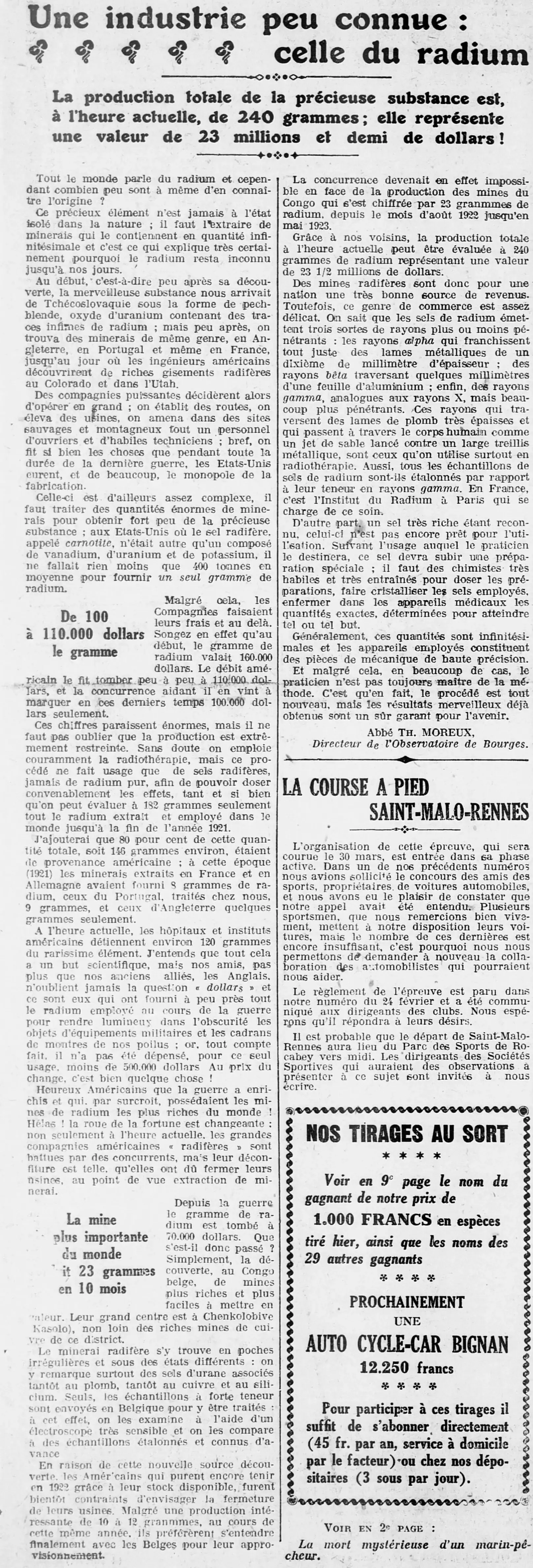
A little-known industry: radium
Everyone talks about radium and yet how few are able to know its origin?
This precious element is never in an isolated state in nature; it must be extracted from ores which contain it in infinitesimal quantities and this certainly explains why radium remained unknown until today. At the beginning, that is to say shortly after its discovery, the marvelous substance came to us from Czechoslovakia in the form of pech-blende, uranium oxide containing minute traces of radium; but soon after, ores of the same kind were found in England, Portugal and even France, until the day when American engineers discovered rich radiferous deposits in Colorado and Utah.
Powerful companies then decided to operate on a large scale; roads were established, factories were built, a whole staff of workers and skilled technicians were brought to wild and mountainous sites; In short, things were done so well that for the duration of the last war, the United States had, by far, a monopoly on manufacturing.
This is also quite complex; it is necessary to process enormous quantities of ores to obtain very little of the precious substance; in the United States where salt radiates. called carnotite, was none other than a compound of vanadium, uranium and potassium, it took no less than 400 tonnes on average to provide a single gram of radium.
Despite this, the Companies made their expenses and beyond. Consider that at the beginning, a gram of radium was worth $160,000. American sales brought it down little by little to 110,000 dollars, and with the help of competition it came to mark in recent times only 100,000 dollars.
These figures seem enormous, but we must not forget that production is extremely limited. No doubt radiotherapy is commonly used, but this process only uses radiiferous salts, never pure radium, in order to be able to properly dose the effects, so much so that all the extracted radium can be estimated at only 182 grams and employed worldwide until the end of 1921.
I would add that 80 percent of this total quantity, or approximately 146 grams, was of American origin; at that time (1921) the ores extracted in France and Germany had provided 8 grams of radium, those from Portugal, processed here, 9 grams, and those from England only a few grams.
Currently, American hospitals and institutes hold approximately 120 grams of the extremely rare element. I understand that all this has a scientific purpose, but our friends, no more than our former allies, the English, never forget the "dollars" question and it is they who provided almost all the radium used during the of war to make objects of military equipment and the watch dials of our furry luminous in the dark; Now, all things considered, less than $500,000 was spent for this purpose alone. At the exchange rate, that's quite something!
Happy Americans who were enriched by the war and who, what's more, owned the richest radium mines in the world! Alas! the wheel of fortune is changing: not only are the large American "radiferous" companies currently being beaten by competitors, but their discomfiture is such that they have had to close their factories, from the extraction point of view. ore.
Since the war, a gram of radium has fallen to $70,000. So what happened? Simply, the discovery, in the Belgian Congo, of mines that are richer and easier to develop. Their large center is at Chenkolobive Kasolo, not far from the rich copper mines of this district.
The radiiferous ore is found there in irregular pockets and in different states: we especially notice uranium salts associated sometimes with lead, sometimes with copper and silicon. Only the high content samples are sent to Belgium for processing: for this purpose, they are examined using a very sensitive electroscope and compared to calibrated samples known in advance.
Due to this new discovered source, the Americans, who were still able to hold out in 1922 thanks to their available stock, were soon forced to consider closing their factories. Despite an interesting production of 10 to 12 granmmes, during that same year, they preferred to finally come to an agreement with the Belgians for their supply.
Competition became in fact impossible in the face of the production of Congo mines which amounted to 23 grams of radium, from August 1922 to May 1923.
Thanks to our neighbors, the total production at present can be estimated at 240 grams of radium representing a value of 23 1/2 million dollars.
Radial mines are therefore a very good source of income for a nation. However, this type of trade is quite delicate. We know that radium salts emit three kinds of more or less penetrating rays: alpha rays which barely penetrate metal blades one tenth of a millimeter thick; beta rays passing through a few millimeters of aluminum foil; finally, gamma rays, similar to X-rays, but much more penetrating. These rays which pass through very thick lead blades and which pass through the human body like a jet of sand thrown against a large metal mesh, are those which are mainly used in radiotherapy. Also, all radium salt samples are calibrated against their gamma ray content. In France, it is the Radium Institute in Paris which is responsible for this treatment.
On the other hand, a very rich salt being recognized, it is not yet ready for use. Depending on the use for which the practitioner intends it, this salt will have to undergo special preparation; Very skilled and highly trained chemists are needed to dose the preparations, crystallize the salts used, and enclose in the medical devices the exact quantities determined to achieve this or that goal. Generally, these quantities are infinitesimal and the devices used constitute high-precision mechanical parts. And despite this, in many cases, the practitioner is not always master of the method.
In fact, the process is completely new, but the wonderful results already obtained are a sure guarantee for the future.
Abbot TH. MOREUX,
Director of the Bourges Observatory. |