

| La Presse 29 février 1924 |
|
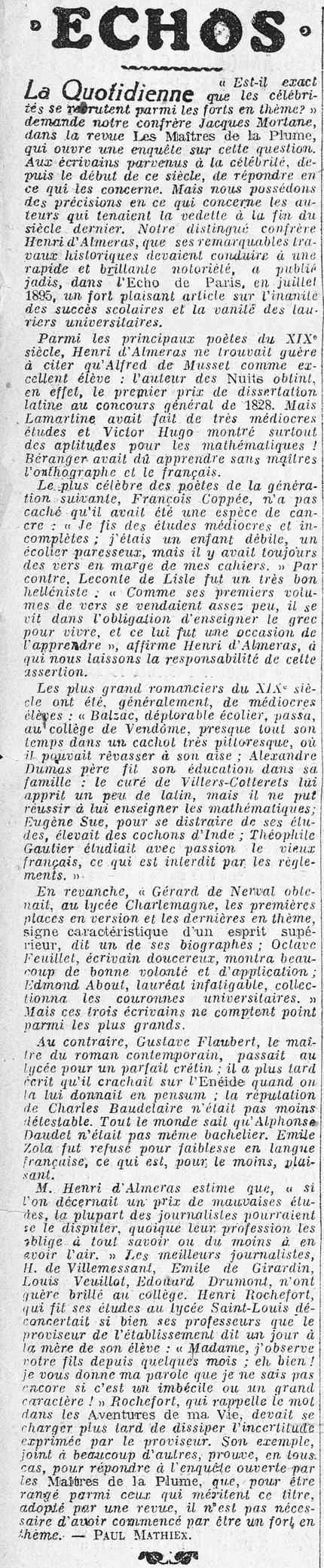
ECHOS
The Daily “Is it true that celebrities are recruited from the strong in theme? » asks our colleague Jacques Mortane, in the magazine Les Maîtres de la Plume, who is opening an investigation into this question.
It is up to writers who have achieved fame since the beginning of this century to respond as far as they are concerned. But we do have details regarding the authors who were in the spotlight at the end of the last century.
Our distinguished colleague Henri d'Almeras, whose remarkable historical work was to lead to rapid and brilliant notoriety, once published, in the Echo de Paris, in July 1895, a very pleasant article on the inanity of academic success and the vanity of academic laurels.
Among the main poets of the 19th century, Henri d'Almeras could only cite Alfred de Musset as an excellent student: the author of Les Nuits obtained, in fact, first prize for Latin dissertation in the general competition of 1828.
But Lamartine had done very mediocre studies and Victor Hugo showed above all aptitude for mathematics! Béranger had to learn spelling and French without teachers.
The most famous poet of the following generation, François Coppée, did not hide the fact that he had been a kind of dunce: “I had mediocre and incomplete studies; I was a stupid child, a lazy schoolboy, but there were always verses in the margins of my notebooks. »
On the other hand, Leconte de Lisle was a very good Hellenist: “As his first volumes of verse sold relatively little, he saw himself obliged to teach Greek in order to live, and this was an opportunity for him to learn it” , affirms Henri d'Almeras, to whom we leave the responsibility for this assertion.
The greatest novelists of the 19th century were, generally, mediocre students “Balzac, a deplorable schoolboy, spent, at the college of Vendôme, almost all his time in a very picturesque dungeon, where he could daydream at his ease; Alexandre Dumas senior was educated in his family, the priest of Villers-Cotterets taught him a little Latin, but he could not succeed in teaching him mathematics;
Eugène Sue, to distract himself from his studies, raised guinea pigs; Théophile Gautier studied old French with passion, which is prohibited by the regulations. »
On the other hand, “Gérard de Nerval obtained, at the Charlemagne high school, the first places in version and the last in theme, a characteristic sign of a superior mind,” says one of his biographers; Octave Feuillet, a sweet writer, showed a lot of good will and application; Edmond About, tireless winner, collected university crowns. » But these three writers are not among the greatest.
On the contrary, Gustave Flaubert, the master of the contemporary novel, was considered a complete moron at high school; he later wrote that he spat on the Aeneid when it was given to him as a pensum;
Charles Baudelaire's reputation was no less detestable. Everyone knows that Alphonse Daudet did not even have a bachelor's degree. Emile Zola was rejected for weakness in the French language, which is, to say the least, pleasant.
Mr. Henri d'Almeras believes that, if a prize were awarded for poor studies, most journalists could compete for it, although their profession requires them to know everything or at least to appear to do so. »
The best journalists, H. de Villemessant, Emile de Girardin, Louis Veuillot, Edouard Drumont, hardly shone at college. Henri Rochefort, who studied at the Saint-Louis high school, disconcerted his teachers so much that the principal of the establishment said one day to the mother of his student: “Madame, I have been observing your son for several months; well! I give you my word that I don’t yet know if he’s an imbecile or a great character!” Rochefort, who recalls the word in the Adventures of my Life, was later to take charge of dissipating the uncertainty expressed by the headmaster.
His example, joined to many others, proves, in any case, to respond to the investigation opened by the Masters of the Pen, that, to be ranked among those who deserve this title, adopted by a review, he It is not necessary to have started by being strong in theme.
PAUL MATHEIX.
|
 |