

| Excelsior 29 février 1924 |
|
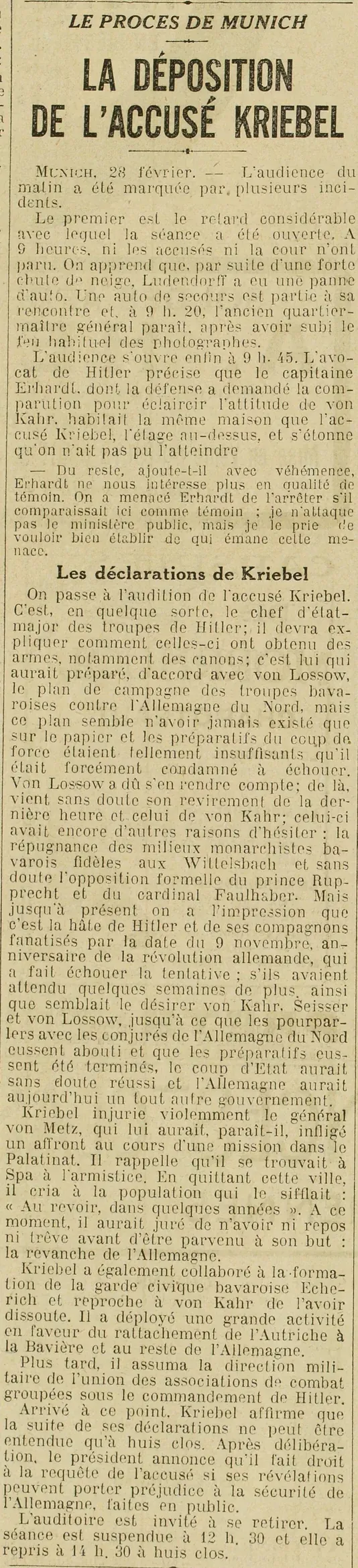
THE MUNICH TRIAL
THE DEPOSITION OF THE ACCUSED KRIEBEL
MUNICH, February 28. The audience of the evil one was marked by several incidents.
The first is the considerable delay with which the session was opened. At 9 o'clock, neither the accused nor the court appeared. We learned that, following a heavy snowfall, Ludendorff had a car breakdown. A rescue car went to meet him and, at 9 a.m. 20, the former quartermaster general appears, after having suffered the usual fire from photographers.
The hearing finally opens at 9 a.m. 45. Hitler's lawyer specifies that Captain Erhardt, whose defense requested the appearance to clarify von Kahr's attitude. lived in the same house as the accused Kriebel, the floor above, and was surprised that no one could reach him
Besides, he adds vehemently, Erhardt no longer interests us as a witness. Erhardt was threatened with arrest if he appeared here as a witness. I am not attacking the public prosecutor, but I ask him to please establish who this threat emanates from.
Kriebel's statements
We move on to the hearing of the accused Kriebel. He is, in a way, the chief of staff of Hitler's troops; he will have to explain how they obtained weapons, in particular cannons; it was he who would have prepared, in agreement with von Lossow, the campaign plan for the Bavarian troops against North Germany, but this plan seems to have only ever existed on paper and the preparations for the coup were so insufficient that it was necessarily doomed to fail.
Von Lossow must have realized this; hence undoubtedly comes his last-hour change of heart and that of von Kahr; he had other reasons to hesitate: the repugnance of Bavarian monarchist circles loyal to the Wittelsbachs and undoubtedly the formal opposition of Prince Rupprecht and Cardinal Faulhaber.
But until now we have the impression that it was the haste of Hitler and his companions, fanaticized by the date of November 9, the anniversary of the German revolution, which caused the attempt to fail; if they had waited a few more weeks, as von Kahr seemed to want. Seisser and von Lossow, until the talks with the North German conspirators had been successful and the preparations had been completed, the coup would undoubtedly have succeeded and Germany would today have a whole other government.
Kriebel violently insults General von Metz, who is said to have inflicted an affront on him during a mission in the Palatinate. He recalls that he was in Spa at the armistice. As he left this town, he shouted to the people who were whistling at him: “Goodbye, in a few years.” At that moment, he would have sworn to have neither rest nor truce until he had achieved his goal: the revenge of Germany.
Kriebel also collaborated in the formation of the Bavarian Echerich Civic Guard and blamed von Kahr for disbanding it. He deployed great activity in favor of the attachment of Austria to Bavaria and the rest of Germany.
Later he assumed military leadership of the union of combat associations grouped under the command of Hitler. At this point Kriebel asserts that the rest of his statements can only be heard behind closed doors.
After deliberation, the president announced that he would grant the accused's request if his revelations could harm the security of Germany, made in public. The audience is asked to leave. The meeting adjourned at 12 p.m. 30 and it resumed at 2:30 p.m. behind closed doors.
|
 |