

| Le Petit Écho de la mode 06 juillet 1924 |
|
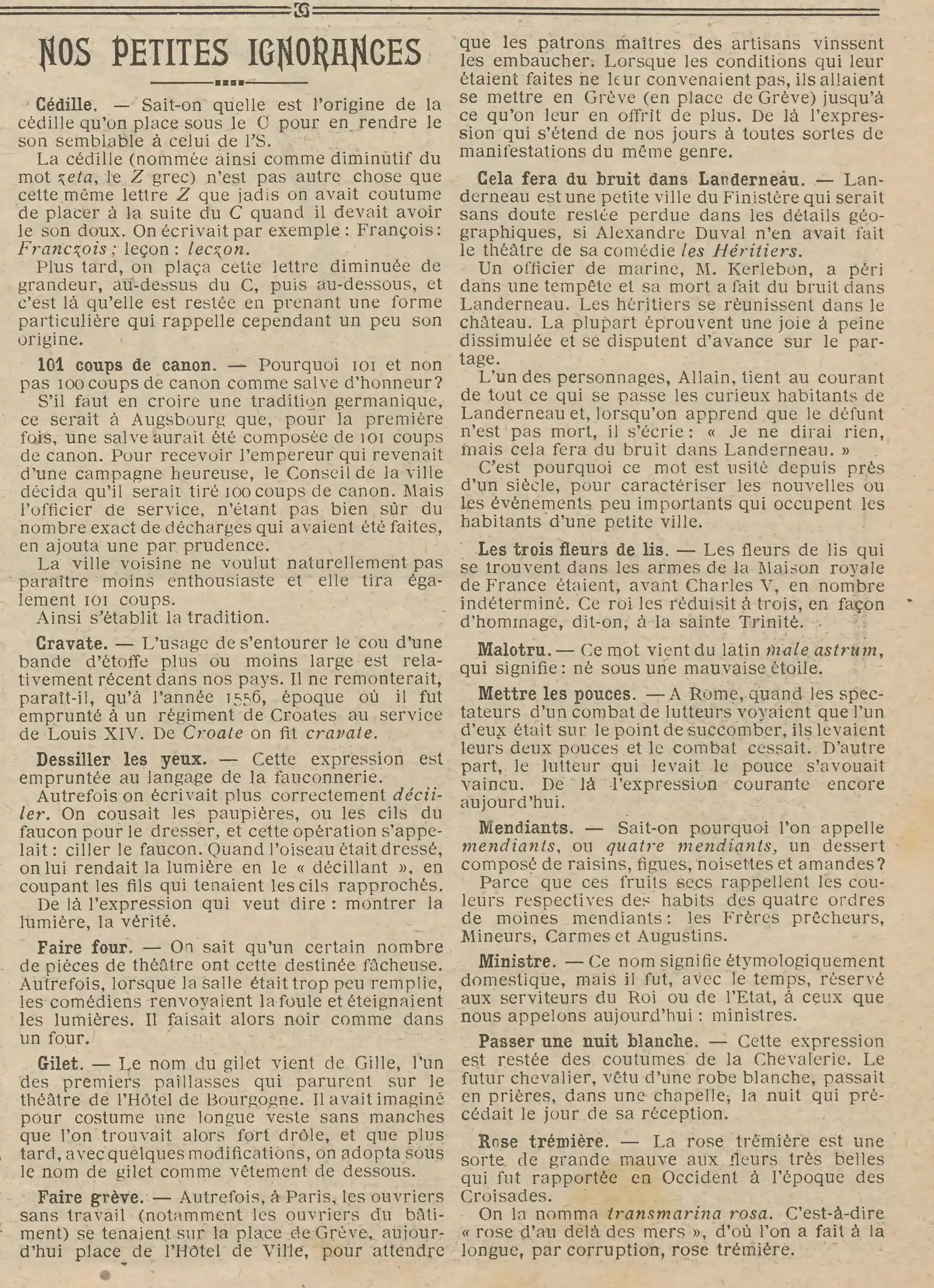
OUR LITTLE IGNORANCES Cédille. Do we know the origin of the cedilla that we place under the C to make its sound similar to that of the S? The cedilla (so named as a diminutive of the word zeta, the Greek Z) is nothing other than the same letter Z that used to be placed after the C when it had to have a soft sound. For example, we wrote: François: Franczois; lesson: lesson. Later, this letter, reduced in size, was placed above the C, then below, and that is where it remained, taking a particular shape which nevertheless recalls a little its origin. 101 cannon shots. Why 101 and not 100 cannon shots as a salute? If we are to believe a Germanic tradition, it would be in Augsburg that, for the first time, a salvo would have been composed of 101 cannon shots. To receive the emperor who was returning from a successful campaign, the city council decided that 100 cannon shots would be fired. But the officer on duty, not being sure of the exact number of discharges that had been made, added one out of caution. The neighboring town naturally did not want to appear less enthusiastic and also fired 101 rounds. Thus the tradition is established. Tie. The custom of surrounding one's neck with a more or less wide band of fabric is relatively recent in our countries. It only dates back, it seems, to the year 1556, when it was borrowed from a regiment of Croats in the service of Louis XIV. From Croatian we made a tie. Open your eyes. - This expression is borrowed from the language of falconry. In the past we wrote deciller more correctly. The eyelids or eyelashes of the falcon were sewn together to train it, and this operation was called: blinking the falcon. When the bird was trained, the light was restored to it by “unpickling” it, by cutting the threads that held the eyelashes together. Hence the expression which means: to show the light, the truth. Bake. We know that a certain number of plays have this unfortunate destiny. In the past, when the room was too small, the actors would send the crowd away and turn off the lights. It was then dark as in an oven. Vest. The name of the vest comes from Gille, one of the first pallasses who appeared on the theater of the Hôtel de Bourgogne. He had imagined a long sleeveless jacket for his costume, which we found very funny at the time, and which later, with a few modifications, was adopted under the name of vest as an undergarment. OUR LITTLE IGNORANCES Cédille. Do we know the origin of the cedilla that we place under the C to make its sound similar to that of the S? The cedilla (so named as a diminutive of the word zeta, the Greek Z) is nothing other than the same letter Z that used to be placed after the C when it had to have a soft sound. For example, we wrote: François: Franczois; lesson: lesson. Later, this letter, reduced in size, was placed above the C, then below, and that is where it remained, taking a particular shape which nevertheless recalls a little its origin. 101 cannon shots. Why 101 and not 100 cannon shots as a salute? If we are to believe a Germanic tradition, it would be in Augsburg that, for the first time, a salvo would have been composed of 101 cannon shots. To receive the emperor who was returning from a successful campaign, the city council decided that 100 cannon shots would be fired. But the officer on duty, not being sure of the exact number of discharges that had been made, added one out of caution. The neighboring town naturally did not want to appear less enthusiastic and also fired 101 rounds. Thus the tradition is established. Tie. The custom of surrounding one's neck with a more or less wide band of fabric is relatively recent in our countries. It only dates back, it seems, to the year 1556, when it was borrowed from a regiment of Croats in the service of Louis XIV. From Croatian we made a tie. Open your eyes. - This expression is borrowed from the language of falconry. In the past we wrote deciller more correctly. The eyelids or eyelashes of the falcon were sewn together to train it, and this operation was called: blinking the falcon. When the bird was trained, the light was restored to it by “unpickling” it, by cutting the threads that held the eyelashes together. Hence the expression which means: to show the light, the truth. Bake. We know that a certain number of plays have this unfortunate destiny. In the past, when the room was too small, the actors would send the crowd away and turn off the lights. It was then dark as in an oven. Vest. The name of the vest comes from Gille, one of the first pallasses who appeared on the theater of the Hôtel de Bourgogne. He had imagined a long sleeveless jacket for his costume, which we found very funny at the time, and which later, with a few modifications, was adopted under the name of vest as an undergarment. |
 |
| retour - back 06 juillet 1924 |