

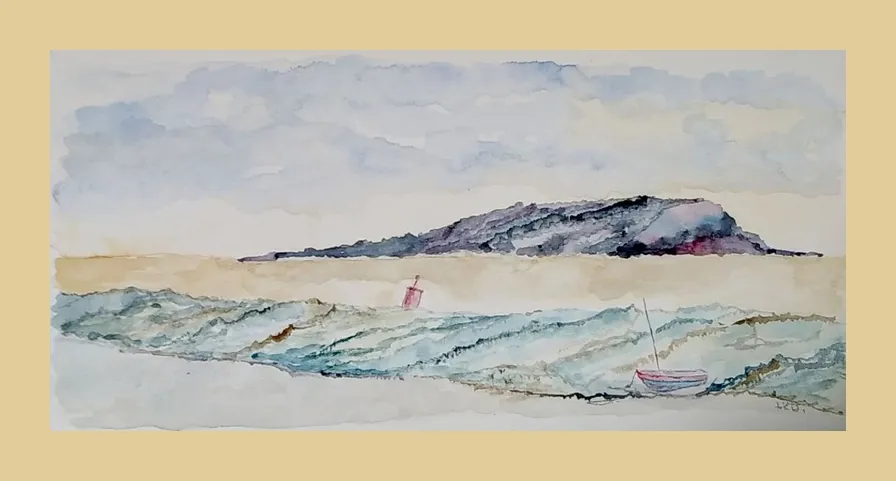
| Le Petit Journal illustré 17 août 1924 |
|
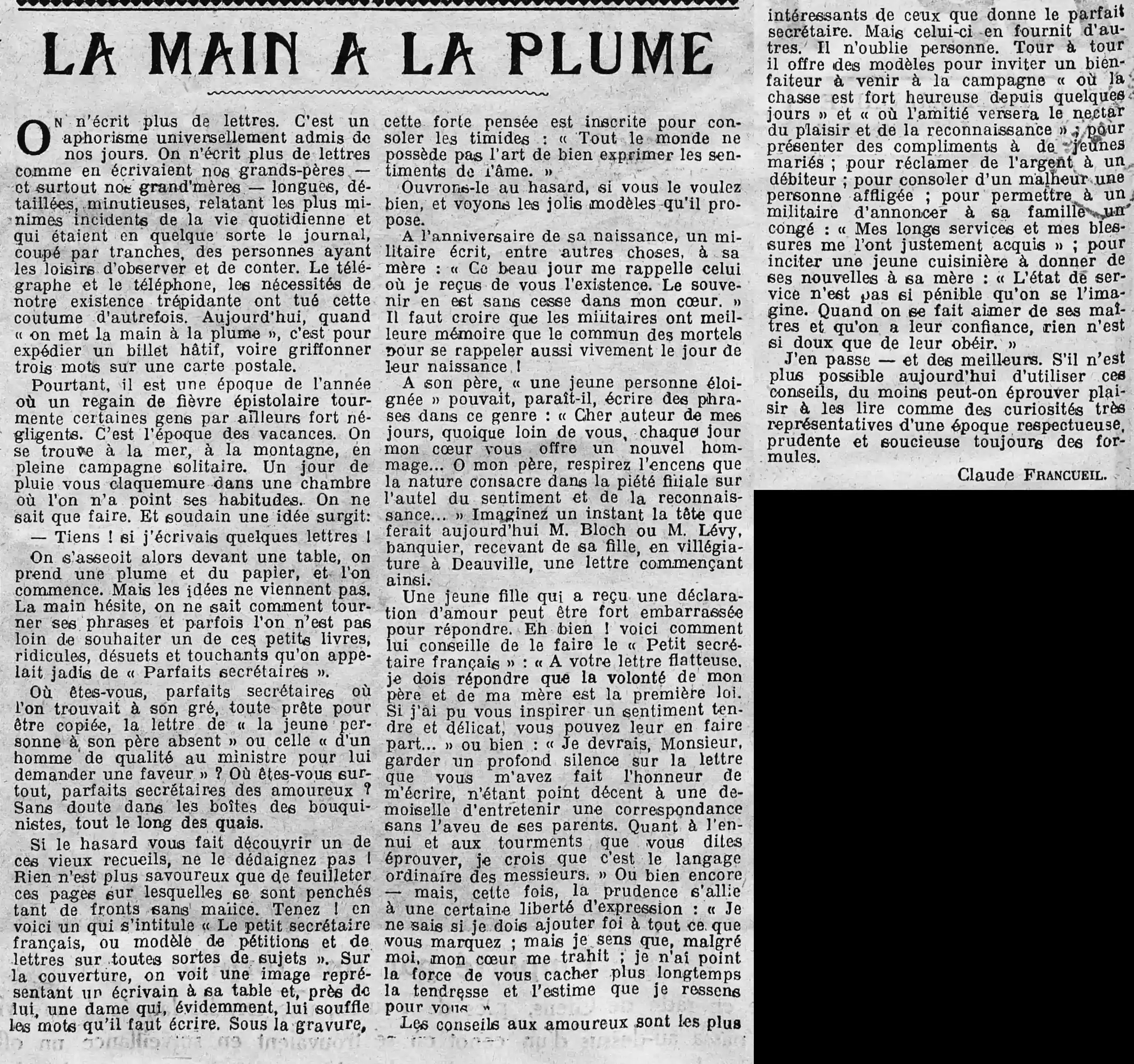
WE no longer write letters. It is a universally accepted aphorism these days. We no longer write letters as our grandfathers and especially our grandmothers used to write, long, detailed, meticulous, relating the most minor incidents of daily life and which were in a way the journal, cut into sections, of people who had the leisure to observe and tell stories. The telegraph and the telephone, the necessities of our hectic existence have killed this custom of yesteryear. Today, when "we put our hand to the pen", it is to send a hasty note, or even scribble three words on a postcard. However, there is a time of year when a resurgence of epistolary fever torments certain people who are otherwise very negligent. It is the holiday season. We find ourselves at the seaside, in the mountains, in the middle of the lonely countryside. A rainy day shuts you up in a room where you are not used to it. We don't know what to do. And suddenly an idea arises: Hey, let me write a few letters! We sit down at a table, take a pen and paper, and begin. But the ideas don't come. The hand hesitates, we don't know how to turn our sentences and sometimes we are not far from wishing for one of those little books, ridiculous, old-fashioned and touching, that were once called "Perfect secretaries". Where are you, perfect secretaries where one could find at will, all ready to be copied, the letter from "the young person to her absent father" or that "from a man of quality to the minister to ask him a favor"? Where are you above all, perfect secretaries of lovers? No doubt in the boxes of the second-hand booksellers, all along the quays. If chance brings you to discover one of these old collections, do not disdain it. Nothing is more delightful than leafing through these pages on which so many brows have bent without malice. Here is one entitled "The little French secretary, or model of petitions and letters on all sorts of subjects". On the cover, we see pictures representing a writer at his table and, near him, a lady who, obviously, whispers to him the words that must be written. Under the engraving, this strong thought is written to console the timid: "Not everyone possesses the art of expressing well the feelings of the soul." Let us open it at random, if you will, and see the pretty models that it proposes. On the anniversary of his birth, a soldier wrote, among other things, to his mother "This beautiful day reminds me of the one on which I received existence from you. The memory of it is constantly in my heart. » It must be believed that soldiers have a better memory than ordinary mortals to remember so vividly the day of their birth! To her father, "a distant young person" could, it seems, write sentences like this: "Dear author of my days, although far from you, each day my heart offers you a new homage... O my father, breathe the incense that nature consecrates in filial piety on the altar of sentiment and gratitude..." Imagine for a moment the face that Mr. Bloch or Mr. Lévy, banker, would make today, receiving from his daughter, on vacation in Deauville, a letter beginning like this. A young girl who has received a declaration of love can be very embarrassed to respond. Well! here is how the "Little French Secretary" advises her to do it: "To your flattering letter, I must respond that the will of my father and mother is the first law. If I have been able to inspire in you a tender and delicate feeling, you can share it with them... " or else: "I should, Sir, keep a profound silence on the letter that you have done me the honor of writing to me, it being not decent for a young lady to maintain a correspondence without the consent of her parents. As for the boredom and torment that you say you experience, I believe that this is the ordinary language of gentlemen." Or again, but this time, prudence is combined with a certain freedom of expression: "I do not know if I should believe all that you write; but I feel that, in spite of myself, my heart betrays me; I do not have the strength to hide from you any longer the tenderness and esteem that I feel for you" The advice to lovers is the most interesting of those given by the perfect secretary. But this one provides others. He forgets no one. In turn he offers models for inviting a benefactor to come to the country "where hunting has been very happy for a few days" and "where friendship will pour the nectar of pleasure and gratitude" to present compliments to young married people to claim money from a debtor; to console an afflicted person for a misfortune; to allow a soldier to announce to his family a leave "My long service and my injuries have justly acquired it for me"; to encourage a young cook to give news of her to her mother: "The state of service is not as painful as one imagines. When one makes oneself loved by one's masters and one has their confidence, nothing is so sweet as to obey them." I pass over - and the best. If it is no longer possible today to use these tips, at least one can experience pleasure in reading them as curiosities very representative of a respectful, prudent era, always concerned with formulas Claude FRANCUEIL. |
 |
| retour - back 17 août 1924 |