

| Excelsior 17 août 1924 |
|
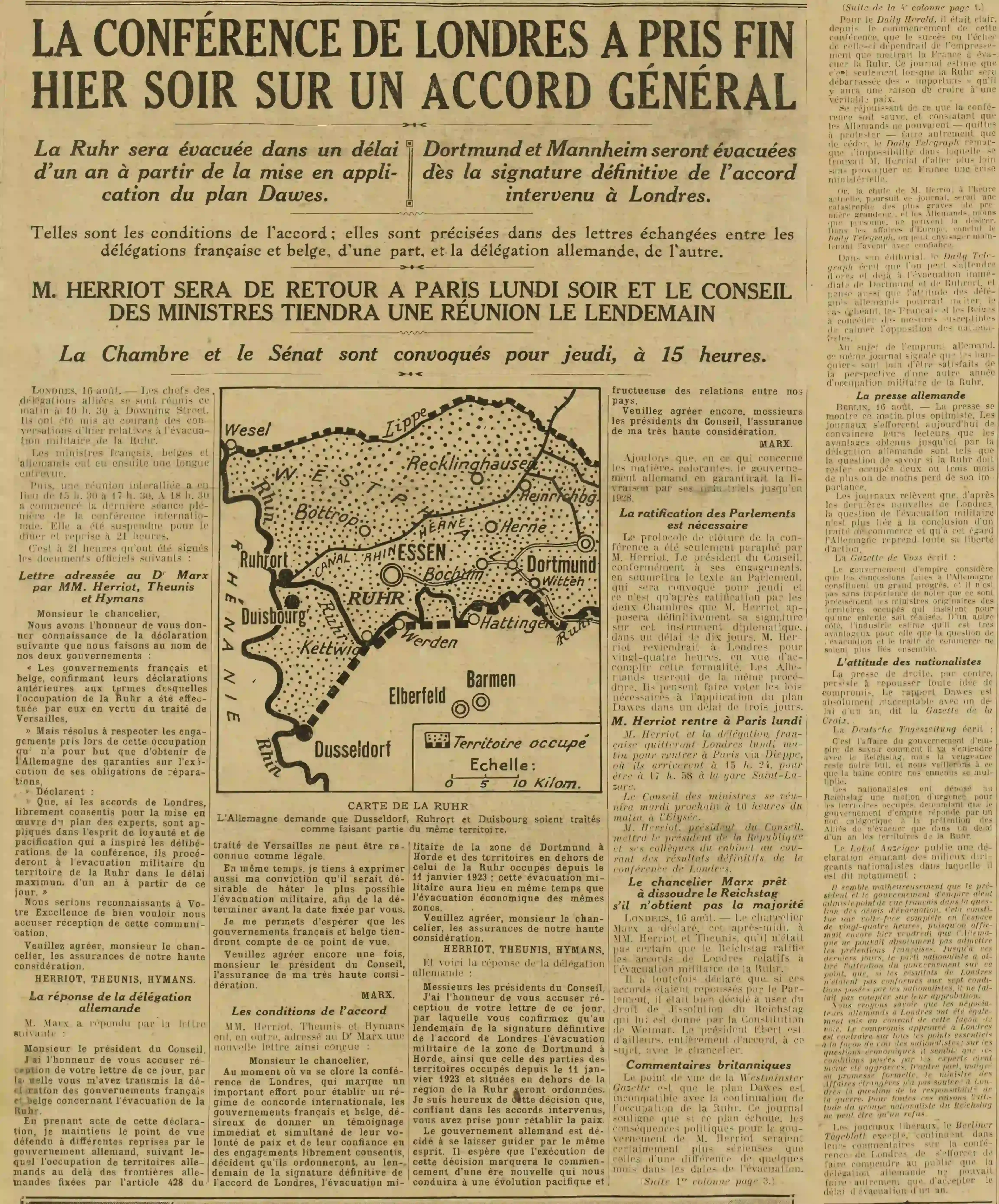
THE LONDON CONFERENCE CLOSED LAST NIGHT WITH A GENERAL AGREEMENT Dortmund and Mannheim will be evacuated as soon as the agreement reached in London is finally signed. The Ruhr will be evacuated within a year of the implementation of the Dawes Plan. These are the conditions of the agreement; they are specified in letters exchanged between the French and Belgian delegations, on the one hand, and the German delegation, on the other. M. HERRIOT WILL RETURN TO PARIS MONDAY EVENING AND THE COUNCIL OF MINISTERS WILL HOLD A MEETING THE FOLLOWING DAY The Chamber and the Senate are convened for Thursday, at 3 p.m. LONDON, August 16. The heads of the Allied delegations met this morning at 10:30 a.m. in Downing Street. They were informed of yesterday's conversations regarding the military evacuation of the Ruhr. The French, Belgian and German ministers then had a long interview. Then an inter-allied meeting took place from 3:30 p.m. to 5:30 p.m. At 6:30 p.m. the last plenary session of the international conference began. It was suspended for dinner and resumed at 9 p.m. At 9 p.m. the following official documents were signed: Letter addressed to Dr. Marx by MM. Herriot, Theunis and Hymans Mr. Chancellor, « We have the honour to inform you of the following declaration that we are making on behalf of our two governments: Declare: That, if the London agreements, freely agreed to for the implementation of the experts' plan, are applied in the spirit of loyalty and pacification which inspired the deliberations of the conference, they will proceed to the military evacuation of the territory of the Ruhr within a maximum period of one year from this day. We would be grateful if Your Excellency would acknowledge receipt of this communication. Please accept, Mr. Chancellor, the assurances of our highest consideration. » HERRIOT, THEUNIS, HYMANS. The reply of the German delegation « Mr. President of the Council, I have the honor to acknowledge receipt of your letter of today, by which you transmitted to me the declaration of the French and Belgian governments concerning the evacuation of the Ruhr. At the same time, I also wish to express my conviction that it would be desirable to hasten the military evacuation as much as possible, in order to determine it before the date fixed by you. I venture to hope that the French and Belgian governments will take this point of view into account. Please accept once again, Mr. President of the Council, the assurance of my highest consideration. » The conditions of the agreement Messrs. Herriot, Theunis and Hymans have, in addition, addressed to Dr. Marx a new letter worded as follows:
Mr. Chancellor, And here is the reply of the German delegation: Let us add that, as regards the colouring materials, the German government would guarantee their delivery by its manufacturers until 1928. Ratification by Parliaments is necessary Mr. Herriot returns to Paris on Monday Mr. Herriot, President of the Council, will inform the President of the Republic and his colleagues in the cabinet of the final results of the London conference. Chancellor Marx ready to dissolve the Reichstag if he does not obtain a majority LONDON, August 16. Chancellor Marx declared this afternoon to Messrs. Herriot and Theumis that he was not certain that the Reichstag would ratify the London agreements concerning the military evacuation of the Ruhr. He declared, however, that if these agreements were rejected by Parliament, he was determined to exercise the right to dissolve the Reichstag given to him by the Weimar Constitution. President Ebert is, moreover, in complete agreement, on this subject, with the Chancellor. British Comments The Westminster Gazette's view is that the Dawes Plan is incompatible with the continued occupation of the Ruhr. This paper points out that if this plan fails, the political consequences for Mr. Herriot's Government would certainly be more serious than those of a difference of a few months in the dates of the evacuation. (Continued from the 1st column on page 3.) (Continued from the 4th column on page 1.). To the Daily Herald, it was clear from the beginning of this conference, that its success or failure would depend on the alacrity with which France would evacuate the Ruhr. This paper considers that it is only when the Ruhr is cleared of "unwelcomes" that there will be any reason to believe in a real peace. Rejoicing that the conference was saved, and noting that the Germans could not, even if they had to protest, do otherwise than give in, the Daily Telegraph notes the impossibility in which M. Herriot found himself to go further without provoking a ministerial crisis in France. Now, the fall of M. Herriot at the present time, continues this newspaper, would be a most serious catastrophe (of the first magnitude), and the Germans, least of all, cannot desire it. In European affairs, concludes the Daily Telegraph, one can now look to the future with confidence. In its editorial, the Daily Telegraph writes that one can already expect the immediate evacuation of Dortmund and Ruhrort, and also thinks that the altitude of the German delegates could, if necessary, prevent the French and the Belgians from conceding measures likely to calm the opposition of the nationalists. On the subject of the German loan. The same newspaper reports that bankers are far from satisfied with the prospect of another year of military occupation of the Ruhr. The German Press BERLIN, August 16. The press is more optimistic this morning. The newspapers are trying to convince their readers today that the advantages obtained so far by the German delegation are such that the question of whether the Ruhr should remain occupied two or three months longer or less is losing its importance. The newspapers point out that, according to the latest news from London, the question of military evacuation is no longer linked to the conclusion of a trade treaty and that in this respect Germany is regaining full freedom of action. The Voss Gazette writes: The imperial government considers the concessions made to Germany to be a great step forward, and it is not without importance to note that it is precisely the ministers from the occupied territories who are insisting on an agreement being reached. On the other hand, industry considers it very advantageous for it that the question of evacuation and the trade treaty are no longer linked together. The attitude of the nationalists The right-wing press, on the other hand, persists in rejecting any idea of compromise. The Dawes report is absolutely acceptable with a one-year deadline, says the Gazette de la Croir. The Deutsche Tageszeitung writes: It is the business of the imperial government to know how it will come to an agreement with the Reichstag, but revenge remains our goal, and we will see to it that hatred against our enemies multiplies. The nationalists have tabled an emergency motion in the Reichstag for the occupied territories, demanding that the imperial government respond with a categorical no to the Allies' claim to evacuate the Ruhr territories within a year only. The Lokul Anzeiger publishes a statement from the nationalist leadership in which it is said in particular: It seems unfortunately that the president and the imperial government have accepted the French point of view on the question of evacuation deadlines. This constitutes a complete about-face in the space of twenty-four hours, since it was still being asserted yesterday, Friday, that Germany could absolutely not accept the French claims. The liberal newspapers, with the exception of the Berliner Tageblatt, continued in their comments on the London conference to try to make the public understand that the German delegation could not do otherwise than accept the one-year evacuation period. |
 |
| retour - back 17 août 1924 |