

|
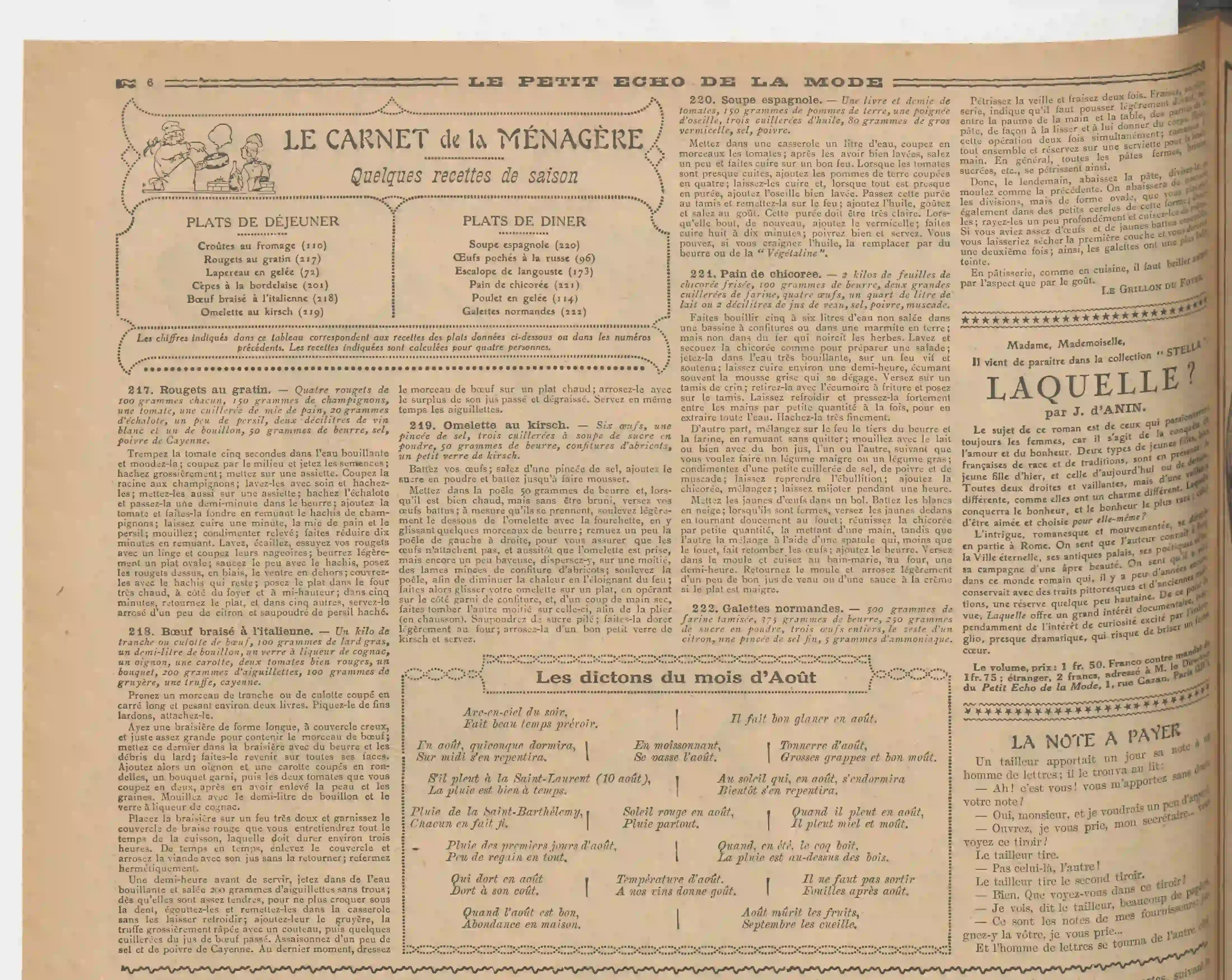
LUNCH DISHES Cheese crusts (110) DINNER DISHES Spanish soup (220) 217. Red mullet au gratin. Four red mullet of 100 grams each, 150 grams of mushrooms, a tomato, a spoonful of breadcrumbs, 20 grams of shallot, a little parsley, two deciliters of white wine and one of broth, 50 grams of butter, salt, cayenne pepper. Dip the tomato for five seconds in boiling water and peel it; cut in half and discard the seeds; chop coarsely; put on a plate. Cut the root of the mushrooms; wash them carefully and chop them; put them also on a plate; chop the shallot and pass it for half a minute in the butter; add the tomato and melt it while stirring the chopped mushrooms; let cook for a minute, the breadcrumbs and the parsley; moisten; season with salt; reduce for ten minutes while stirring. Wash, scale, dry your red mullet with a cloth and cut off their fins; lightly butter an oval dish; sauce it a little with the mince, place the red mullet on top, at an angle, belly out; cover them with the remaining mince; place the dish in the very hot oven, next to the burner and halfway up; in five minutes, turn the dish over, and in another five, serve it sprinkled with a little lemon and chopped parsley. 218. Italian-style braised beef. One kilo of beef slices or thighs, 100 grams of fatty bacon, half a liter of stock, a liqueur glass of cognac, an onion, a carrot, two very red tomatoes, a bouquet, 200 grams of aiguillettes, 100 grams of Gruyere, a truffle, cayenne. Take a piece of beef or loin cut into a long square and weighing about two pounds. Prick it with thin bacon, tie it. Have a long braising pan, with a hollow lid, and just large enough to contain the piece of beef; put the latter in the braising pan with butter and the remains of the bacon; brown it on all sides. Then add an onion and a carrot cut into slices, a bouquet garni, then the two tomatoes that you cut in half, after having removed the skin and seeds. Moisten with the half-liter of broth and the liqueur glass of cognac. Place the braising pan on a very low heat and garnish the lid with red embers that you will maintain throughout the cooking time, which should last about three hours. From time to time, remove the lid and baste the meat with its juice without turning it; close hermetically. Half an hour before serving, throw 200 grams of holeless aiguillettes into boiling salted water; as soon as they are tender enough to no longer crunch under the tooth, drain them and put them back in the pan without letting them cool; add the Gruyere, the truffle coarsely grated with a knife, then a few spoonfuls of the beef juice. Season with a little salt and cayenne pepper. At the last moment, arrange the piece of beef on a hot dish; baste it with the excess of its juice, strained and degreased. Serve the aiguillettes at the same time. 219. Omelette with kirsch. Six eggs, a pinch of salt, three tablespoons of powdered sugar, 50 grams of butter, apricot jam, a small glass of kirsch. Beat your eggs; salt with a pinch of salt, add the caster sugar and beat until frothy. Put 50 grams of butter in the pan and, when it is very hot, but not browned, pour in your beaten eggs; as they set, lift the underside of the omelette slightly with the fork, slipping in a few pieces of butter; shake the pan a little from left to right, to make sure that the eggs do not stick, and as soon as the omelette is set, but still a little runny, scatter thin slices of apricot jam on one half; lift the pan, in order to reduce the heat by moving it away from the fire; then slide your omelette onto a plate, working on the side garnished with jam, and, with a sharp blow of the hand, drop the other half on it, in order to fold it (into a turnover). Sprinkle with crushed sugar; brown it lightly in the oven; sprinkle it with a good little glass of kirsch and serve. 220. Spanish soup. A pound and a half of tomatoes, 150 grams of potatoes, a handful of sorrel, three spoonfuls of oil, 80 grams of large vermicelli, salt, pepper. Put a liter of water in a saucepan, cut the tomatoes into pieces; after having washed them well, salt a little and cook over a good fire. When the tomatoes are almost cooked, add the potatoes cut into quarters; let them cook and, when everything is almost pureed, add the sorrel bi washed. Pass this puree through a sieve and put it back on the fire; add the oil, taste and salt to taste. This puree should be very clear. When it boils, again, add the vermicelli; cook for eight to ten minutes; pepper well and serve. You can, if you are afraid of oil, replace it with butter or Végétaline". 221. Chicory bread. 2 kilos of curly chicory leaves, 100 grams of butter, two large spoonfuls of flour, four eggs, a quarter of a liter of milk or 2 deciliters of veal juice, salt, pepper, nutmeg. Boil five to six liters of unsalted water in a jam pan or in an earthenware pot; but not in iron which blackens the herbs. Wash and shake the chicory as if preparing a salad; throw it into very boiling water, on a high and sustained heat; let cook for about half an hour, often skimming off the gray foam that comes off. Pour onto a horsehair sieve; remove it with the frying skimmer and place on the sieve. Let cool and squeeze it firmly between your hands in small quantities at a time, to extract all of it water. Chop it very finely. On the other hand, mix on the fire a third of the butter and the flour, stirring without stopping; moisten with the milk or with good juice, one or the other, according to whether you want to make a lean vegetable or a fatty vegetable; season with a small spoonful of salt, pepper and nutmeg; let it boil again; add the chicory, mix; let it simmer for an hour. Put the egg yolks in a bowl. Beat the whites until stiff; when they are firm, pour the yolks into them, stirring gently with a whisk; gather the chicory in small quantities, putting it in one hand, while the other mixes it with the help of a spatula which, less than the whisk, makes the eggs fall back; add the butter. Pour into the mold and cook in a bain-marie, in the oven, for half an hour. Turn the mold over and lightly baste with a little good veal juice or a cream sauce if the dish is lean. 222. Normandy Galettes. 500 grams of sifted flour, 375 grams of butter, 250 grams of caster sugar, three whole eggs, the zest of a lemon, a pinch of fine salt, 5 grams of ammonia. Knead the day before and mill twice. Milling, in pastry, indicates that you have to push lightly in front, between the palm of the hand and the table, parts of the dough, so as to smooth it and give it body. Do this operation twice simultaneously; gather everything together and set aside on a napkin for the next day. In general, all firm, shortcrust, sweet, etc. doughs are kneaded this way. So, the next day, roll out the dough, divide it and mold like the previous one. We will lower the divisions again, but in an oval shape, which you will also place in small circles of this shape; score them a little deeply and cook them in the same way. Brown them. If you had enough eggs and yolks beaten together, you would let the first layer dry and brown them a second time; thus, the cakes have a more beautiful color. In pastry, as in cooking, you must shine as much by the appearance as by the taste. THE HOUSE'S WIFE CRICKET |
 |
| Retour - Back 24 août 1924 |