

| Les Nouvelles de Versailles 24 août 1924 |
|
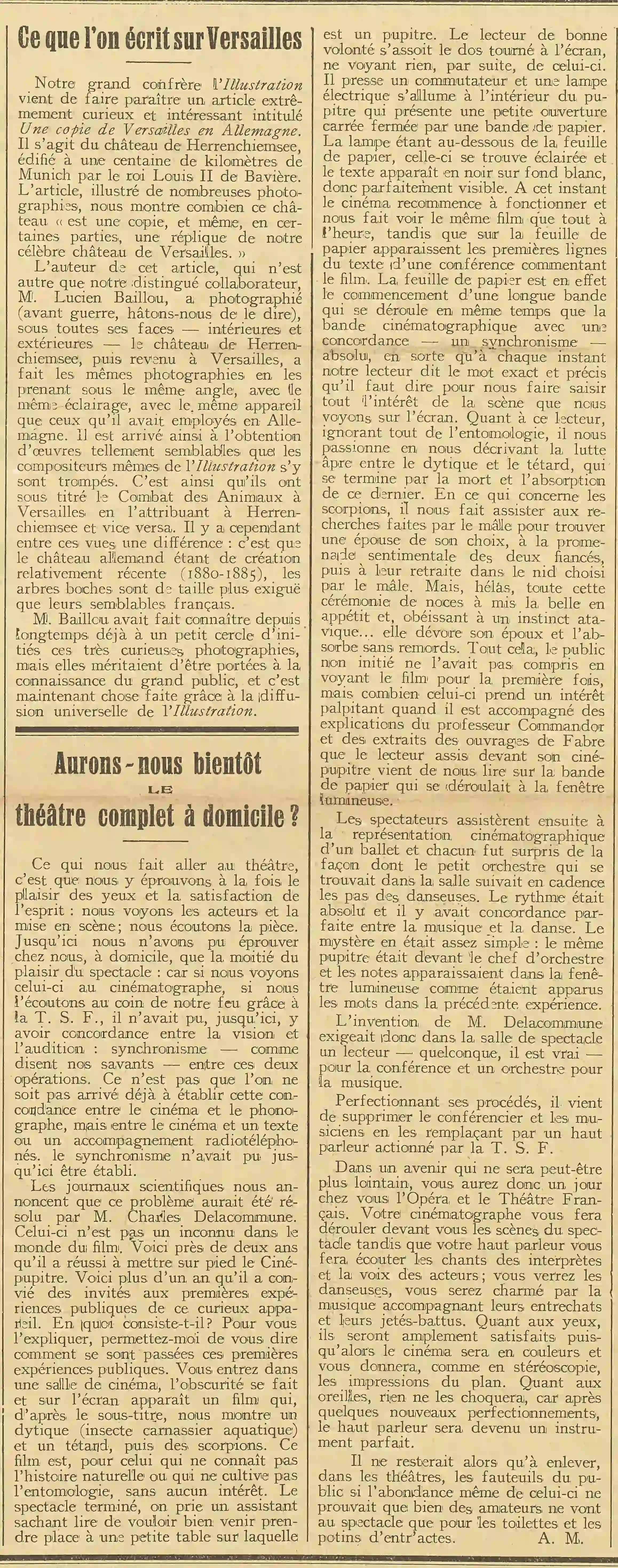
Will we soon have the complete theatre at home? What makes us go to the theatre is that we experience there both the pleasure of the eyes and the satisfaction of the mind: we see the actors and the staging; we listen to the play. Until now we have only been able to experience at home, at home, half the pleasure of the show: because if we see it on the cinematograph, if we listen to it by our fireside thanks to the T. S. F., there has not been, until now, concordance between vision and hearing: synchronism as our scientists say between these two operations. It is not that we have not already succeeded in establishing this concordance between the cinema and the phonograph, but between the cinema and a text or a radiotelephone accompaniment. synchronism had not been able to be established until now. The scientific journals announce to us that this problem would have been solved by Mr. Charles Delacommune. This one is not unknown in the world of film. It has been nearly two years since he succeeded in setting up the Cinépupitre. It has been over a year since he invited guests to the first public experiments of this curious device. What does it consist of? To explain it to you, allow me to tell you how these first public experiments took place. You enter a movie theater, darkness falls and on the screen appears a film which, according to the subtitle, shows us a dytiscidae (aquatic carnivorous insect) and a tadpole, then scorpions. This film is, for those who do not know natural history or who do not cultivate entomology, of no interest at all. When the show is over, an assistant who can read is asked to come and take a seat at a small table on which is a lectern. The willing reader sits with his back turned to the screen, seeing nothing of it, as a result. He presses a switch and an electric lamp comes on inside the desk, which has a small square opening closed by a strip of paper. The lamp being below the sheet of paper, it is lit and the text appears in black on a white background, therefore perfectly visible. At this moment the cinema starts working again and shows us the same film as before, while on the sheet of paper appear the first lines of the text of a conference commenting on the film. The sheet of paper is in fact the beginning of a long strip which unfolds at the same time as the film strip with concordance and absolute synchronism, so that at each moment our reader says the exact and precise word which must be said to make us grasp all the interest of the scene which we see on the screen. As for this reader, ignorant of entomology, he fascinates us by describing the bitter struggle between the diving beetle and the tadpole, which ends with the death and absorption of the latter. As for the scorpions, he makes us witness the searches made by the male to find a wife of his choice, the sentimental stroll of the two fiancés, then their retreat to the nest chosen by the male. But, alas, all this wedding ceremony has whetted the beauty's appetite and, obeying an atavistic instinct... she devours her husband and absorbs him without remorse. The uninitiated public had not understood all this when seeing the film for the first time, but how much it takes on a thrilling interest when it is accompanied by the explanations of Professor Commandor and the extracts from Fabre's works that the reader sitting in front of his cine-pupitre has just read to us on the strip of paper that was unrolling at the bright window. The spectators then attended the cinematographic representation of a ballet and each was surprised by the way in which the small orchestra that was in the room followed in cadence the steps of the dancers. The rhythm was absolute and there was perfect concord between the music and the dance. The mystery was quite simple: the same desk was in front of the conductor and the notes appeared in the luminous window as the words had appeared in the previous experiment. Mr. Delacommune's invention therefore required in the auditorium some kind of reader, it is true for the lecture and an orchestra for the music. Perfecting his methods, he has just eliminated the lecturer and the musicians by replacing them with a loudspeaker activated by the T. S. F. In a future that may not be far away, you will one day have the French Opera and Theatre in your home. Your cinematograph will unfold the scenes of the show before you while your loudspeaker will make you listen to the songs of the performers and the voices of the actors; you will see the dancers, you will be charmed by the music accompanying their entrechats and their jetés-battus. As for the eyes, they will be amply satisfied since then the cinema will be in color and will give you, as in stereoscopy, the impressions of the shot. As for the ears, nothing will shock them, because after a few new improvements, the loudspeaker will have become a perfect instrument. All that would then remain would be to remove, in the theaters, the seats of the audience if the very abundance of the latter did not prove that many amateurs only go to the show for the toilets and the gossip of intermissions. A. M. |
 |
| Retour - Back 24 août 1924 |