

| L'Œuvre 25 mai 1924 |
|
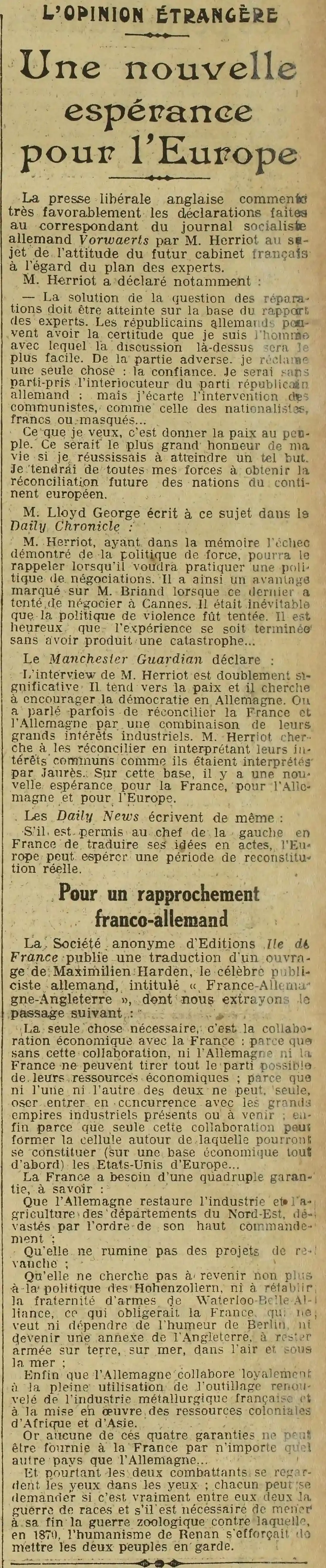
FOREIGN OPINION A new hope for Europe The liberal English press comments very favorably on the statements made to the correspondent of the German socialist newspaper Vorwaerts by Mr. Herriot on the subject of the attitude of the future French cabinet: with regard to the experts' plan. - The solution to the issue of reparations must be reached on the basis of the experts' report. The German republicans can be sure that I am the man with whom the discussion on this will be easiest. From the opposing party. I only ask for one thing: trust. I will be the interlocutor of the German Republican Party without bias; but I rule out the intervention of the communists, like that of the nationalists, frank or masked... Mr. Lloyd George writes on this subject in the Daily Chronicle: Mr. Herriot, having in mind the demonstrated failure of the policy of force, will be able to recall it when he wants to practice a policy of negotiations. He thus had a marked advantage over Mr. Briand when the latter attempted to negotiate in Cannes. It was inevitable that the policy of violence would be attempted. It is fortunate that the experiment ended without having produced a catastrophe... The Manchester Guardian states: Mr. Herriot's interview is doubly significant. He tends towards peace and he seeks to encourage democracy in Germany. There has sometimes been talk of reconciling France and Germany through a combination of their major industrial interests. Mr. Herriot seeks to reconcile them by interpreting their common interests as they were interpreted by Jaurès. On this basis, there is new hope for France, for Germany and for Europe. The Daily News similarly writes: If the leader of the left in France is allowed to translate his ideas into action, Europe can hope for a period of real reconstitution. For a Franco-German rapprochement The Société Anonyme d'Editions Île de France publishes a translation of a work by Maximilien Harden, the famous German publicist, entitled “France-Germany-England”, from which we extract the following passage: The only thing necessary is economic collaboration with France: because without this collaboration, neither Germany nor France can take full advantage of their economic resources; because neither one nor the other of the two can, alone, dare to enter into competition with the great industrial empires present or future; finally because only this collaboration can form the cell around which the United States of Europe can be constituted (on an economic basis first of all). France needs a quadruple guarantee, namely: Let Germany restore the industry and agriculture of the departments of the North-East, devastated by the order of its high command; Let her not brood over plans for revenge; Nor should it seek to return to the policy of the Hohenzollerns, nor to reestablish the brotherhood of arms of Waterloo-Belle Alliance, which would oblige France, which neither wants to depend on the mood of Berlin, nor become an annex of England, to remain armed on land, at sea, in the air and under the sea; Finally, that Germany collaborates loyally in the full use of the renewed tools of the French metallurgical industry and in the implementation of the colonial resources of Africa and Asia. However, none of these four guarantees can be provided to France by any country other than Germany... And yet the two combatants look each other eye to eye; everyone can ask themselves if it is really a war of races between the two of them and if it is necessary to bring to an end the zoological war against which, in 1870, the humanism of Renan strove to put the two peoples in conflict. guard. |
 |
| retour - back 25 mai 1924 |