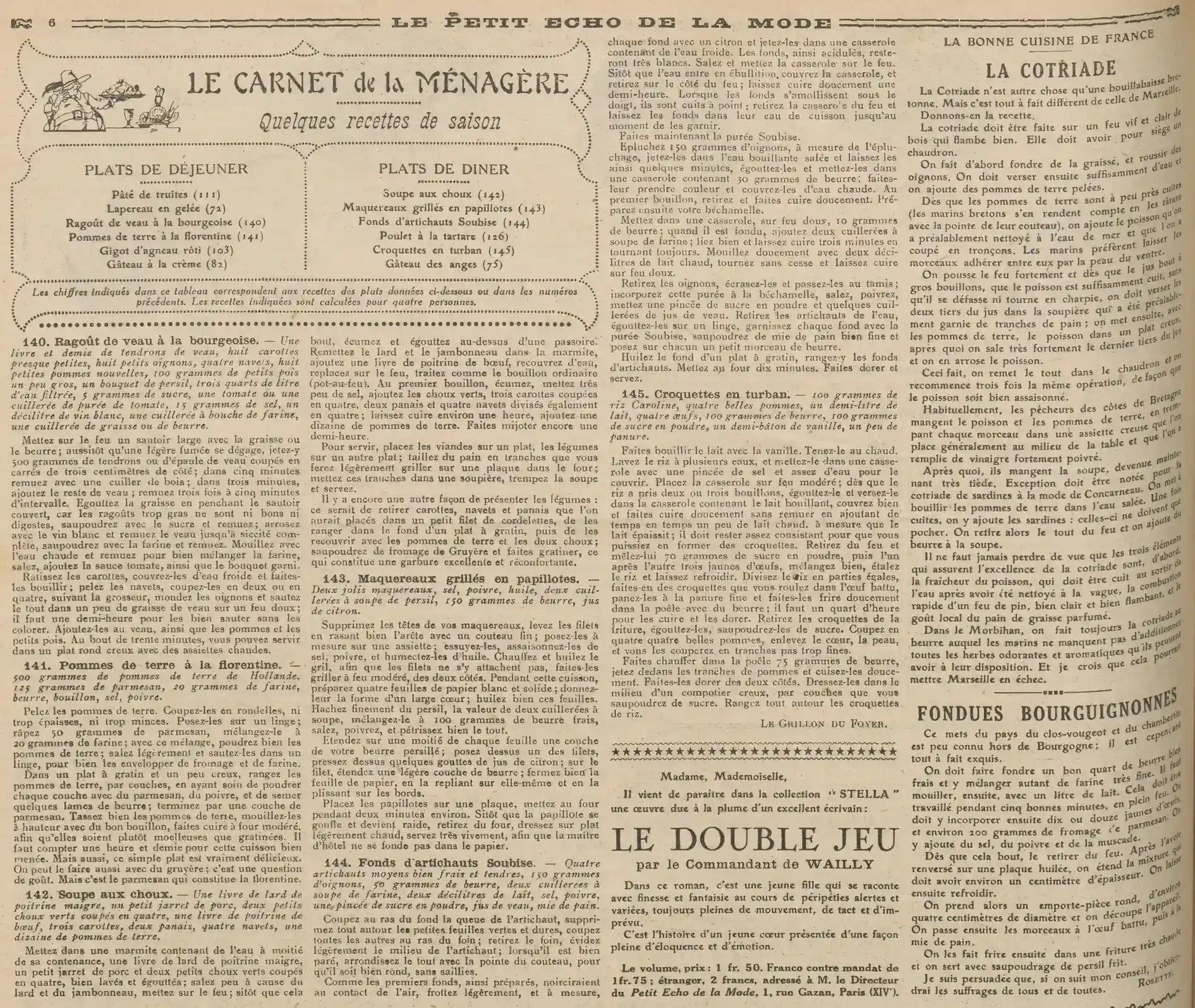
|
LUNCH DISHES
Trout pâté (111)
Rabbit in jelly (72)
Veal stew bourgeoise (140)
Florentine Potatoes (141)
Roast leg of lamb (103)
Cream cake (82)
DINNER DISHES
Cabbage soup (142)
Grilled mackerel in foil (143)
Soubise artichoke bases (144)
Chicken tartare (126)
Turban kibble (145)
Angel food cake (75)
140. Bourgeois-style veal stew.
A pound and a half of veal tendons, eight almost small carrots, eight small onions, four turnips, eight small new apples, 100 grams of slightly large peas, a bunch of parsley, three quarters of a liter of filtered water, 5 grams of sugar, a tomato or a spoonful of tomato puree, 15 grams of salt, a deciliter of white wine, a teaspoonful of flour, a spoonful of fat or butter.
Put a large sauté pan with the fat or butter on the fire; as soon as a slight smoke emerges, throw in 500 grams of tendons or veal shoulder cut into squares of three centimeters on each side; in five minutes stir with a wooden spoon; in three minutes, add the rest of the veal; stir three times at five minute intervals. Drain the fat by tilting the covered sauté pan, because stews that are too fatty are neither good nor digestible, sprinkle with the sugar and stir; sprinkle with the white wine and stir the veal until completely dry, sprinkle with the flour and stir. Add hot water and stir to mix the flour, salt, add the tomato sauce and the bouquet garni. Rake the carrots, cover them with cold water and boil them; peel the turnips, cut them in half or quarters, depending on their size, add the onions and sauté everything in a little veal fat over a low heat; it takes half an hour to sauté them well without coloring them. Add them to the veal, as well as the apples and peas. After thirty minutes, you can serve in a deep round dish with warm plates.
141. Florentine potatoes.
500 grams of Dutch potatoes, 125 grams of parmesan, 20 grams of flour, butter, broth, salt, pepper.
Peel the potatoes. Cut them into slices, neither too thick nor too thin. Place them on a cloth; grate 50 grams of parmesan, mix it with 20 grams of flour; with this mixture, powder the potatoes well; lightly salt and toss them in a cloth, to wrap them well in cheese and flour.
In a slightly hollow gratin dish, arrange the potatoes, in layers, taking care to powder each layer with parmesan, pepper, and sprinkle a few blades of butter; finish with a layer of parmesan. Pack the potatoes well, moisten them with good stock, cook in a moderate oven, so that they are soft rather than gratinated. It takes an hour and a half for this well-executed cooking process. But also, this simple dish is really delicious. You can also do it with gruyere; It's a question of taste. But it’s the Parmesan that makes up the Florentine.
142. Cabbage soup.
A pound of lean bacon, a small pork shank, two small green cabbages cut into quarters, a pound of beef brisket, three carrots, two parsnips, four turnips, around ten potatoes.
-
Put in a pot containing half its capacity of water, a pound of lean bacon, a small pork shank and two small green cabbages cut into quarters, well washed and drained; add a little salt because of the bacon and ham, put on the fire; as soon as it boils, skim and drain over a strainer. Return the bacon and ham to the pot, add a pound of beef brisket, cover with water, place back on the heat, treat like ordinary broth (pot-au-feu).
To the first broth, skim, add very little salt, add the green cabbage, three carrots cut into quarters, two parsnips and four turnips divided equally into quarters; cook for about an hour, add around ten potatoes. Simmer for another half hour.
To serve, place meats on one dish, vegetables on another dish; cut some bread into slices which you will lightly toast on a baking sheet in the oven; put these slices in a soup bowl, dip the soup and serve.
There is yet another way of presenting the vegetables: it would be to remove carrots, turnips and parsnips which would have been placed in a small net of strings, to arrange them in the bottom of a gratin dish, then to cover with the potatoes and the two cabbages; sprinkle with Gruyère cheese and brown, which makes an excellent and comforting garnish.
143. Grilled mackerel in foil.
Two pretty mackerels, salt, pepper, oil, two tablespoons of parsley, 150 grams of butter, lemon juice.
Remove the heads from your mackerel, remove the fillets by shaving the edges well with a fine knife; place them on a plate; dry them, season them with salt, pepper, and moisten them with oil. Heat and oil the grill, so that the fillets do not stick to it, grill them over moderate heat, on both sides.
While this is cooking, prepare four sheets of sturdy white paper; give them the shape of a large heart; oil these leaves well. Finely chop the parsley, two tablespoons worth, mix it with 100 grams of fresh butter, salt, pepper, and knead everything well.
Spread a layer of your parsley butter on half of each sheet; place one of the fillets on top, squeeze a few drops of lemon juice on it; on the fillet, spread a light layer of butter; Close the sheet of paper tightly, folding it on itself and creasing it at the edges.
Place the papillotes on a baking sheet and put in the oven for about two minutes. As soon as the papillote swells and becomes stiff, remove from the oven, place on a slightly warm dish, serve very quickly, so that the maître d' does not melt into the paper.
144. Soubise artichoke bases.
Four very fresh and tender medium artichokes, 150 grams of onions, 50 grams of butter, two tablespoons of flour, two deciliters of milk, salt, pepper, a pinch of powdered sugar, veal juice, bread crumbs.
Cut the tail of the artichoke flush with the bottom, remove the small, hard green leaves all around, cut all the others flush with the hay; remove the hay, slightly hollow out the middle of the artichoke; when it is well trimmed, round everything off with the tip of the knife, so that it is very round, without protrusions.
As the first bases, thus prepared, would blacken on contact with air, lightly rub each base with a lemon and throw them into a saucepan containing cold water. The funds, thus tangy, will remain very white.
Add salt and put the pan on the heat. As soon as the water comes to a boil, cover the pan, and remove to the side of the heat; let it cook gently for half an hour. When the bases soften under the finger, they are cooked to perfection; remove the pan from the heat and leave the bases in their cooking water until ready to garnish them.
Now make the Soubise puree…
Peel 150 grams of onions, as they are peeled, throw them into boiling salted water and leave them like that for a few minutes, drain them and put them in a saucepan containing 30 grams of butter; let them turn color and cover them with hot water. At the first boil, remove and cook gently. Then prepare your béchamelle.
Put 10 grams of butter in a saucepan over low heat; when it is melted, add two tablespoons of flour; bind well and cook for three minutes, always turning. Gently add two deciliters of hot milk, stir constantly and cook over low heat.
Remove the onions, crush them and pass them through a sieve; add this puree to the béchamelle, salt, pepper, add a pinch of powdered sugar and a few spoonfuls of veal juice. Remove the artichokes from the water, drain them on a cloth, garnish each base with the Soubise puree, sprinkle with fine bread crumbs and place a small piece of butter on each.
Oil the bottom of a gratin dish, place the artichoke bottoms there. Put in the oven for ten minutes. Brown and serve.
145. Turban kibble.
100 grams of Caroline rice, four large apples, half a liter of milk, four eggs, 100 grams of butter, 100 grams of caster sugar, half a stick of vanilla, a little breading.
Boil the milk with the vanilla. Keep him warm. Wash the rice in several waters, and put it in a saucepan with a pinch of salt and enough water to cover it. Place the saucepan over moderate heat; as soon as the rice has boiled two or three times, drain it and pour it into the saucepan containing the boiling milk, cover well and cook gently without stirring, adding a little hot milk from time to time, as the milk thickens; it must remain consistent enough for you to form croquettes.
Remove from the heat and mix in 70 grams of powdered sugar, then three egg yolks one after the other, mix well, spread the rice and leave to cool. Divide the rice into equal parts, make croquettes which you roll in the beaten egg, bread them with fine breadcrumbs and fry them gently in the pan with butter; it takes a quarter of an hour to cook and brown them.
Remove the croquettes from the frying, drain them, sprinkle them with sugar. Cut four beautiful apples into quarters, remove the core and the skin, and cut them into not too thin slices.
Heat 75 grams of butter in the pan, throw in the apple slices and cook them gently. Brown them on both sides. Arrange them in the middle of a hollow compote bowl, in layers that you sprinkle with sugar. Arrange the rice croquettes all around.
|