

| Comœdia 22 juin 1924 |
|
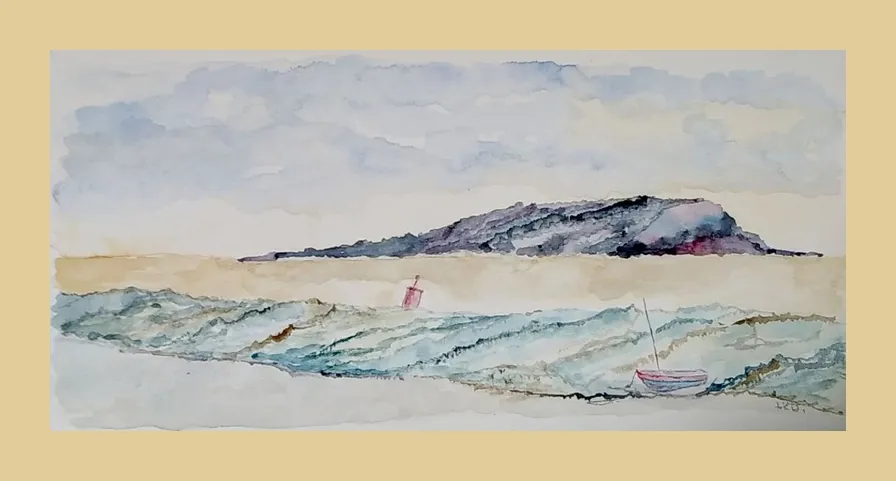
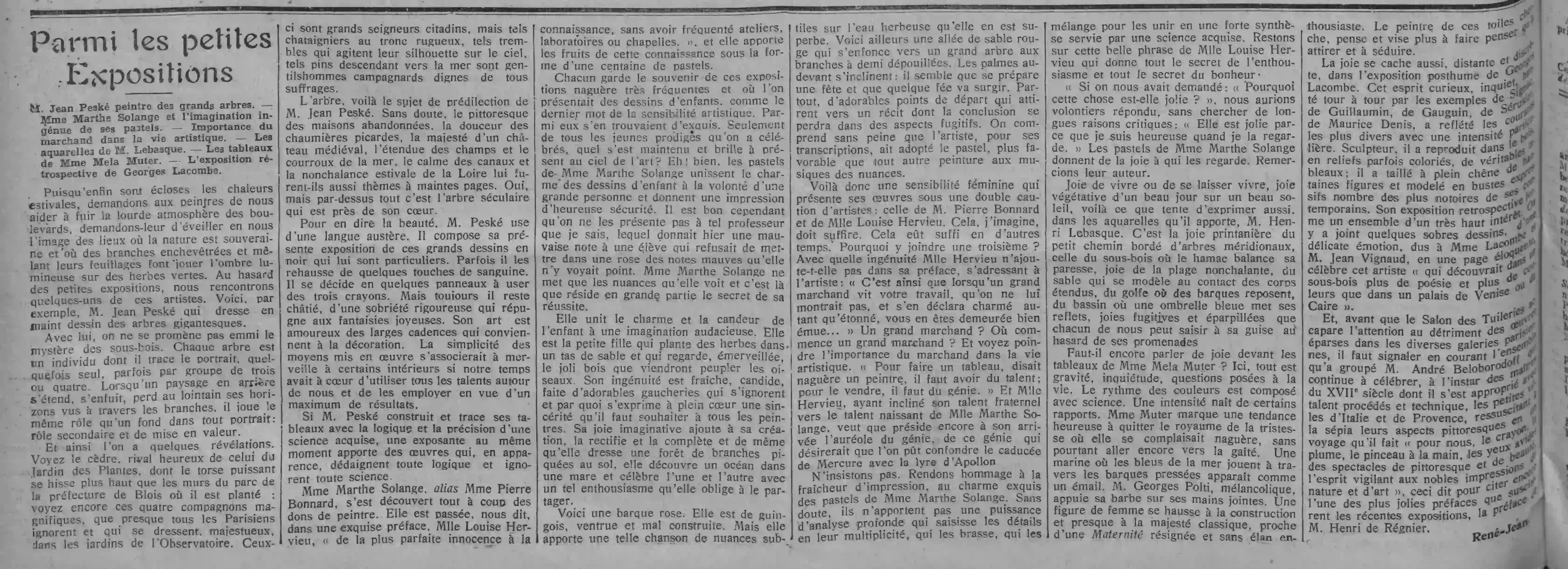
Among the small Exhibitions Mr. Jean Peské painter of large trees. Mrs. Marthe Solange and the ingenuous imagination of her pastels. Importance of the dealer in artistic life. watercolors by Mr. Lebasque. The paintings of Mrs. Mela Muter. The retrospective exhibition of Georges Lacombe. Since the summer heat has finally broken, let us ask painters to help us escape the heavy atmosphere of the boulevards, let us ask them to awaken in us the image of places where nature is sovereign and where tangled branches and mingling their foliage play the luminous shadow on green grass. At random in the small exhibitions, we meet some of these artists. Here, for example, is Mr. Jean Peské who draws gigantic trees in many drawings. With him, we do not walk amidst the mystery of the undergrowth. Each tree is an individual whose portrait he traces, sometimes alone, sometimes in groups of three or four. When a landscape in the background extends, flees, loses its horizons seen through the branches in the distance, it plays the same role as a background in any portrait: a secondary and enhancing role. And thus we have some revelations. See the cedar, a happy rival of that of the Jardin des Plantes, whose powerful torso rises higher than the walls of the park of the prefecture of Blois where it is planted; see again these four magnificent companions, which almost all Parisians ignore and which stand majestically in the gardens of the Observatory. These are great city lords, but such chestnut trees with rough trunks, such aspens that shake their silhouettes against the sky, such pines descending towards the sea are country gentlemen worthy of all suffrages. The tree, that is the favorite subject of Mr. Jean Peské. Without doubt, the picturesqueness of abandoned houses, the sweetness of Picardy cottages, the majesty of a medieval castle, the expanse of fields and the wrath of the sea, the calm of canals and the summer nonchalance of the Loire were also themes on many pages. Yes, but above all it is the ancient tree that is close to his heart. To express its beauty, Mr. Peské uses an austere language. He composes his present exhibition of these large black drawings that are particular to him. Sometimes he enhances them with a few touches of red chalk. He decides to use three pencils in a few panels. But he always remains chastened, with a rigorous sobriety that repels joyful fantasies. His art is in love with the broad cadences that are suitable for decoration. The simplicity of the means used would be a wonderful match for certain interiors if our time were keen to use all the talents around us and to employ them with a view to maximum results. If Mr. Peské constructs and draws his paintings with the logic and precision of an acquired science, an exhibitor at the same time brings works which, in appearance, disdain all logic and ignore all science. Everyone remembers these exhibitions which were once very frequent and where children's drawings were presented, as the last word in artistic sensitivity. Among them were some exquisite ones. Only of all the young prodigies that have been celebrated, which one has remained and shines now in the sky of art? Well, the pastels of Mrs. Marthe Solange unite the charm of a child's drawings with the will of an adult and give an impression of happy security. It is good, however, that they are not introduced to a certain teacher that I know, who yesterday gave a bad mark to a student who refused to put in a rose mauve notes that she did not see there. Mrs. Marthe Solange only puts the nuances that she sees and it is there that lies in large part the secret of her success. She unites the charm and candor of the child with a daring imagination. She is the little girl who plants herbs in a pile of sand and who watches, amazed, the pretty wood that the birds will come to populate. Her ingenuousness is fresh, candid, made of adorable awkwardness that is unaware of itself and by which is expressed from the heart a sincerity that one must wish for all painters. Her imaginative joy adds to her creation, rectifies it and completes it and just as she raises a forest of branches stuck in the ground, she discovers an ocean in a pond and celebrates both with such enthusiasm that she obliges us to share it. Here is a pink boat. It is askew, pot-bellied and poorly built. But it brings such a song of subtle nuances on the grassy water that it is superb. Here elsewhere is a path of red sand that sinks towards a large tree with half-stripped branches. The palms in front lean: it seems that a party is being prepared and that some fairy is about to emerge. Everywhere, adorable starting points that draw towards a story whose conclusion will be lost in fleeting aspects. It is easy to understand that the artist, for his transcriptions, has adopted pastel, more favorable than any other painting to the music of nuances. Here then is a feminine sensibility that presents its works under a double guarantee of artists: that of Mr. Pierre Bonnard and of Miss Louise Hervieu. That, I imagine, must be enough. That would have been enough in other times. Why add a third? With what ingenuousness does Miss Hervieu not add in her preface, addressing the artist: "This is how when a great dealer saw your work, which was not shown to him, and declared himself as charmed as he was astonished, you were very moved by it... A great dealer? Where does a great dealer begin? And see the importance of the dealer in artistic life dawning. "To make a painting," a painter once said, "you have to have talent; to sell it, you have to have genius." And Miss Hervieu, having inclined her fraternal talent towards the nascent talent of Miss Marthe Solange, wants the halo of genius to still preside over her arrival, that genius which would like one to be able to confuse Mercury's caduceus with Apollo's lyre. Let us not insist. Let us pay homage to the freshness of impression, to the exquisite charm of Mrs Marthe Solange's pastels. Doubtless, they do not bring a power of deep analysis that grasps the details in their multiplicity, that mixes them, that blends them to unite them in a strong synthesis served by an acquired science. Let us remain on this beautiful sentence of Miss Louise Hervieu which gives all the secret of enthusiasm and all the secret of happiness. "If we had been asked: "Why is this thing pretty?", we would have willingly answered, without seeking long critical reasons: "It is pretty because I am happy when I look at it." The pastels of Mrs. Marthe Solange give joy to those who look at them. Let us thank their author. Joy of living or of letting oneself live, vegetative joy of a beautiful day on a beautiful sun, this is what Mr. Henri Lebasque also tries to express in the watercolors that he brings. It is the spring joy of the little path lined with southern trees, that of the undergrowth where the hammock swings its laziness, joy of the nonchalant beach, of the sand that is shaped by the contact of the bodies lying down, of the gulf where boats rest, of the basin where a blue umbrella puts its reflections, fleeting and scattered joys that each of us can seize at will during our walks Should we still speak of joy in front of the paintings of Mrs. Mela Muter? Here, everything is serious, worry, questions posed to life. The rhythm of the colors is composed with science. An intensity is born from certain relationships. Mrs. Muter shows a happy tendency to leave the kingdom of sadness where she formerly took pleasure, without however going yet towards gaiety. A seascape where the blues of the sea play through the hurried boats appears like an enamel. Mr. Georges Polti, melancholic, rests his beard on his joined hands. A woman's figure rises to the construction and almost to the classical majesty, close to a resigned Maternity and without enthusiastic momentum. The painter of these canvases seeks, thinks and aims more to make think than to attract and seduce. Joy is also hidden, distant and discreet, in the posthumous exhibition of Georges Lacombe. This curious, restless spirit, haunted in turn by the examples of Signac, Guillaumin, Gauguin, Sérusier, Maurice Denis, reflected the most diverse currents with a particular intensity. Sculptor, he reproduced in wood in reliefs sometimes colored, real paintings; he carved haughty figures in full oak and modeled in expressive busts many of the most notorious of his contemporaries. His retrospective exhibition forms a set of very high interest. We have added some sober drawings, delicate emotion, by Mrs. Lacombe, and Mr. Jean Vignaud, in an eloquent page celebrating this artist "who discovered in an undergrowth more poetry and more colors than in a palace of Venice Cairo" And, before the Salon des Tuileries monopolizes attention to the detriment of the works scattered in the various Parisian galleries, it is necessary to point out in passing the collection that Mr. André Beloborodoff has grouped together, who continues to celebrate, like the masters of the 17th century whose processes and technique he appropriated with talent, the small towns of Italy and Provence, resurrecting in sepia their picturesque aspects in a journey that he makes "for us, pencil, pen, brush in hand, eyes eager for spectacles of the picturesque and beauty, minds alert to the noble impressions of nature and art", this said to quote again one of the prettiest prefaces that the recent exhibitions have given rise to, the preface of Mr. Henri de Régnier. René-Jean |
 |
| retour - back 22 juin 1924 |