

| L'Oeuvre 12 juin 1924 |
|
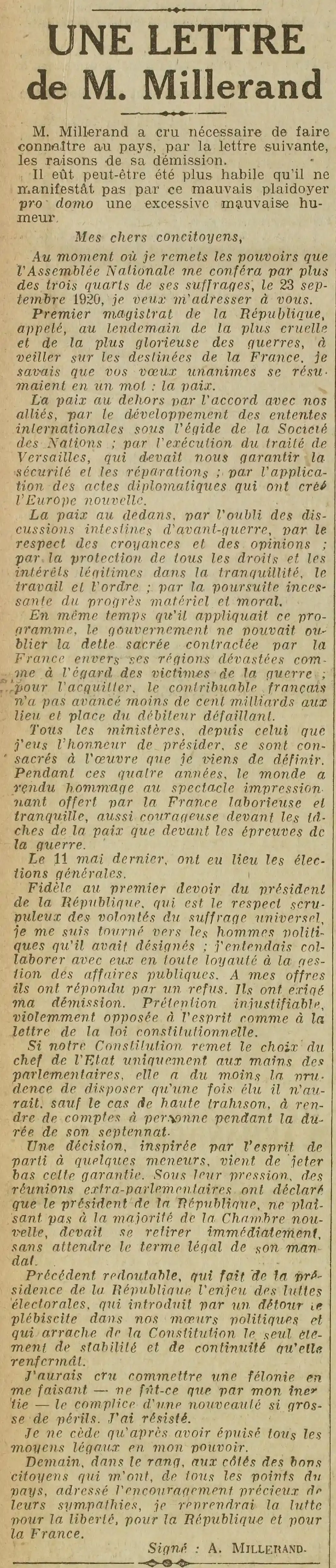
A LETTER from Mr. Millerand Mr. Millerand believed it necessary to make known to the country, by the following letter, the reasons for his resignation. It would perhaps have been more astute if he had not shown by this poor pro domo plea an excessive bad mood. My dear fellow citizens, At the moment when I hand over the powers that the National Assembly conferred on me by more than three-quarters of its votes, on September 23, 1920, I wish to address you. First magistrate of the Republic, called, in the aftermath of the cruelest and most glorious of wars, to watch over the destiny of France. I knew that your unanimous wishes were summed up in one word: peace. Peace abroad through agreement with our allies, through the development of international agreements under the aegis of the League of Nations; through the execution of the Treaty of Versailles, which was to guarantee us security and reparations; by the application of the diplomatic acts that created the new Europe. Peace within, by forgetting the internal discussions of before the war, by respecting beliefs and opinions; by the protection of all rights and legitimate interests in tranquility, work and order; by the incessant pursuit of material and moral progress. At the same time as it applied this program, the government could not forget the sacred debt contracted by France towards its devastated regions as well as towards the victims of the war to pay it, the French taxpayer advanced no less than one hundred billion in place of the defaulting debtor. All the ministries, since the one I had the honor of presiding over, have devoted themselves to the work that I have just defined. During these four years, the world has paid homage to the impressive spectacle offered by hard-working and tranquil France, as courageous in the face of the tasks of peace as in the face of the trials of war. On May 11th, the general elections took place. Faithful to the first duty of the President of the Republic, which is the scrupulous respect of the wishes of universal suffrage, I turned to the politicians he had designated; I intended to collaborate with them in all loyalty in the management of public affairs. They refused my offers. They demanded my resignation. An unjustifiable claim, violently opposed to the spirit as well as the letter of the constitutional law. If our Constitution places the choice of the head of state solely in the hands of parliamentarians, it at least has the prudence to provide that once elected he would not have, except in the case of high treason, to answer to anyone during his seven-year term. A decision, inspired by the party spirit of a few leaders, has just thrown down this guarantee. Under their pressure, extra-parliamentary meetings declared that the President of the Republic, not pleasing the majority of the new Chamber, should retire immediately, without waiting for the legal end of his mandate, A formidable precedent, which makes the presidency of the Republic the stake of electoral struggles, which introduces by a detour the plebiscite into our political customs and which tears from the Constitution the only element of stability and continuity that it contained. I would have believed to commit a felony by making myself - if only by my inertia - the accomplice of a novelty so fraught with peril. I resisted. I yield only after having exhausted all the legal means in my power. Tomorrow, in the ranks, alongside the good citizens who, from all parts of the country, have sent me the precious encouragement of their sympathies, I will resume the fight for freedom, for the Republic and for France. Signed A. MILLERAND |
 |
| retour - back 12 juin 1924 |