


| L'Oeuvre 12 juin 1924 |
|
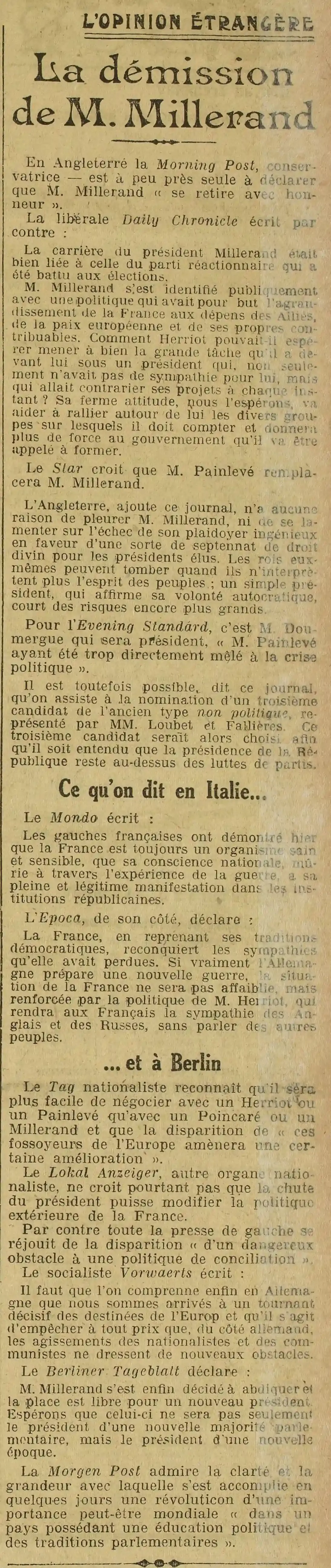
FOREIGN OPINION Mr. Millerand's Resignation In England, the Conservative Morning Post is almost alone in declaring that Mr. Millerand "retires with honour". The Liberal Daily Chronicle, on the other hand, writes: The career of President Millerand was closely linked with that of the reactionary party which was defeated at the elections. Mr. Millerand identified himself publicly with a policy which had for its object the aggrandisement of France at the expense of the Allies, of European peace and of his own taxpayers. How could Herriot hope to carry out the great task before him under a President who not only had no sympathy for him, but who was going to thwart his plans at every moment? His firm attitude, we hope, will help to rally around him the various groups on which he must rely and will give more strength to the government which he is to form. The Star believes that Mr. Painlevé will replace Mr. Millerand. England, adds this newspaper, has no reason to mourn Mr. Millerand, nor to lament the failure of his ingenious plea in favor of a sort of seven-year term by divine right for elected presidents. Kings themselves can fall when they no longer interpret the spirit of the people; a simple president, who asserts his autocratic will, runs even greater risks. For the Evening Standard, it is Mr. Doumergue who will be president, "Mr. Painlevé having been too directly involved in the political crisis." It is however possible, says this newspaper, that we will witness the nomination of a third candidate of the old non-political type, represented by Messrs. Loubet and Fallières. A third candidate would then be chosen so that it is understood that the presidency of the Republic remains above party struggles. What they say in Italy… Le Mondo writes: The French left demonstrated yesterday that France is still a healthy and sensitive organism, that its national conscience, matured through the experience of war, has its full and legitimate manifestation in republican institutions. L'Epoca, for its part, declares: France, by resuming its democratic traditions, is reconquering the sympathies it had lost. If Germany really prepares a new war, the situation of France will not be weakened, but strengthened by the policy of Mr. Herriot, who will restore to the French the sympathy of the English and the Russians, not to mention other peoples. ... and in Berlin The Lokal Anzeiger, another nationalist organ, does not believe that the fall of the president can change France's foreign policy. On the other hand, the entire left-wing press rejoices at the disappearance of "a dangerous obstacle to a policy of conciliation . The socialist Vorwaerts writes: It is necessary that people in Germany finally understand that we have reached a decisive turning point in the destinies of Europe and that it is a question of preventing at all costs that, on the German side, the actions of the nationalists and communists do not raise new obstacles. The Berliner Tageblatt declares: Mr. Millerand has finally decided to abdicate and the place is free for a new president. Let us hope that this one will not only be the president of a new parliamentary majority, but the president of a new era. The Morgen Post admires the clarity and grandeur with which a revolution of perhaps world importance was accomplished in a few days "in a country with political education and parliamentary traditions." |
 |
| retour - back 12 juin 1924 |