

| Le Figaro 22 juin 1924 |
|
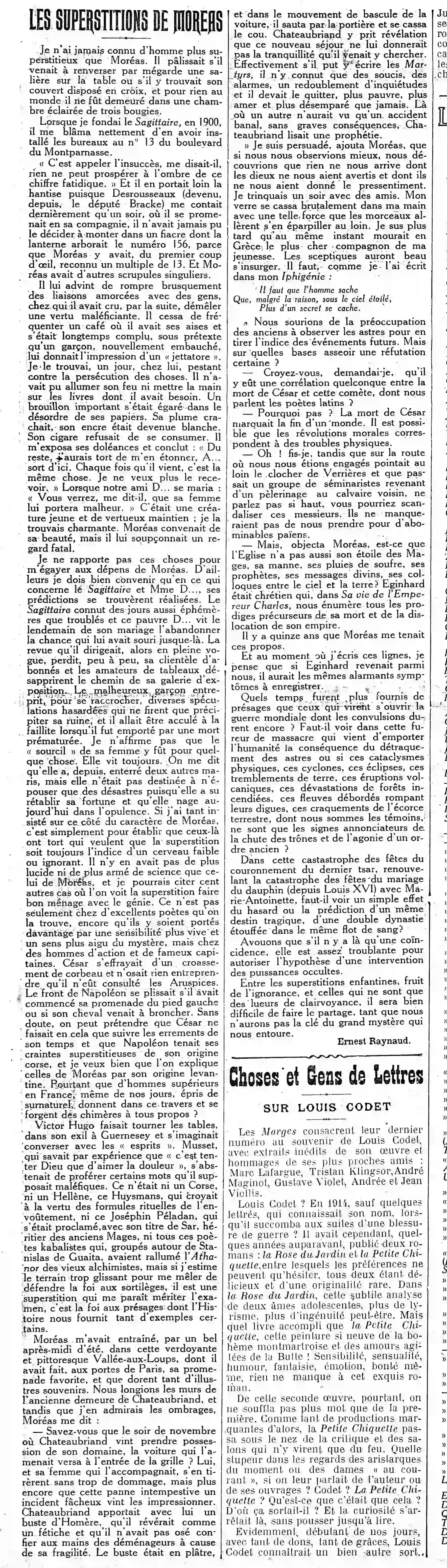
MOREAS' SUPERSTITIONS I have never known a more superstitious man than Moréas. He turned pale if he accidentally knocked over a salt shaker on the table or if he found his cutlery arranged in a cross, and for nothing in the world would he have stayed in a room lit by three candles. When I founded the Sagittaire in 1900, he clearly blamed me for having set up its offices at No. 13 Boulevard du Montparnasse. "That is to call for failure," he told me, "nothing can prosper in the shadow of this fateful number." "And he bore this dread far away, since Desrousseaux (who had since become the deputy Bracke) told me recently that one evening, when he was walking with him, he had never been able to persuade him to get into a cab whose lantern displayed the number 156, because Moréas had, at first glance, recognized it as a multiple of 13. And Moréas had other singular scruples. It happened to him to abruptly break off connections he had started with people in whom he had subsequently believed he had detected a malevolent virtue. He stopped frequenting a café where he was comfortable and had long enjoyed himself, under the pretext that a newly hired boy gave him the impression of a "jettatore". I found him, one day, at home, ranting against the persecution of things. He had been unable to light his fire or get his hands on the books he needed. An important draft had been lost in the disorder of his papers. His pen was spitting, his ink had turned white. His cigar refused to burn. He explained his grievances to me and concluded: "Besides, I would be wrong to be surprised, A... is leaving here. Every time he comes, it's the same thing. I don't want to receive him any more. When our friend D... got married: "You will see," he told me, "that his wife will bring him bad luck." She was a young creature of virtuous demeanor; I found her charming. Moréas agreed on her beauty, but he suspected her of a fatal look. I do not report these things to amuse myself at Moréas's expense. Besides, I must admit that as far as Sagittarius and Mrs. D... are concerned, his predictions were fulfilled. Sagittarius experienced days as ephemeral as they were troubled, and the day after his marriage, poor D... saw the luck that had smiled on him until then abandon him. The magazine he edited, then in full vogue, gradually lost its clientele of subscribers and art lovers forgot the way to his exhibition gallery. The unfortunate boy undertook, in order to hang on, various risky speculations which only hastened his ruin, and he was about to be forced into bankruptcy when he was taken by an untimely death. I do not affirm that his wife's "eyebrow" had anything to do with it. She is still alive. I am told that she has since buried two other husbands, but she was not destined to marry only disasters since she knew how to restore her fortune and is swimming today in opulence. If I have insisted so much on this side of Moréas' character, it is simply to establish that those are wrong who want superstition to always be the sign of a weak or ignorant brain. There was none more lucid or more armed with science than Moréas's, and I could cite a hundred other cases where we see superstition make good bedfellows with genius. It is not only among excellent poets that we find it, although they are more inclined to it by a livelier sensitivity and a keener sense of mystery, but among men of action and famous captains. Caesar was frightened by the croaking of a crow and did not dare to undertake anything without consulting the Aruspices. Napoleon's brow furrowed if he had begun his walk with his left foot or if his horse happened to stumble. No doubt, one can claim that Caesar was only following the errors of his time and that Napoleon held his superstitious fears from his Corsican origin, and I am willing to explain those of Moréas by his Levantine origin. Yet how many superior men in France, even in our days, in love with the supernatural, fall into this fault and create chimeras for themselves on every subject? Victor Hugo, in his exile in Guernsey, was turning tables and imagining himself conversing with the "spirits". Musset, who knew from experience that "it is tempting God to love pain", refrained from uttering certain words that he supposed to be evil. He was neither a Corsican nor a Hellene, this Huysmans, who believed in the virtue of the ritual formulas of bewitchment, nor this Joséphin Péladan, who had proclaimed himself, with his title of Sar, heir to the ancient Magi, nor all these Kabalist poets who, grouped around Stanislas de Guaita, had rekindled the Athanor of the old alchemists, but if I consider the ground too slippery for me to get involved in defending faith in spells, there is one superstition that seems to me to deserve examination, it is faith in omens of which History provides us with so many certain examples. Moréas had led me, one fine summer afternoon, into this verdant and picturesque Vallée-aux-Loups, which he had made, at the gates of Paris, his favorite walk, and which is gilded with so many illustrious memories. We were walking along the walls of Chateaubriand's old residence, and while I was admiring its shade, Moréas said to me: Do you know that on the November evening when Chateaubriand came to take possession of his estate, the carriage that brought him overturned at the entrance to the gate? He and his wife who accompanied him escaped without too much damage, but even more than this untimely breakdown an unfortunate incident came to impress them. Chateaubriand brought with him a bust of Homer, which he revered as a fetish and which he had not dared to entrust to the hands of the movers because of its fragility. The bust was made of plaster, and in the rocking movement of the carriage, he jumped out of the door and broke his neck. Chateaubriand realized that this new residence would not give him the peace and quiet he had come to seek. Indeed, if he was able to write the Martyrs, he only knew worries, alarms, a redoubling of worries and he had to leave it, poorer, more bitter and more distraught than ever. Where another would have seen only a banal accident, without serious consequences, Chateaubriand read a prophecy. I am convinced, added Moréas, that if we observed ourselves more closely, we would discover that nothing happens to us of which the gods have not warned us and of which they have not given us a presentiment. I was toasting one evening with friends. My glass broke brutally in my hand with such force that the pieces scattered far and wide. I learned later that at that very moment, the dearest companion of my youth died in Greece. The skeptics will rebel in vain. It is necessary, as I wrote in my Iphigénie: Man must know We smile at the preoccupation of the ancients with observing the stars to draw from them the clue of future events. But on what basis can we base a certain refutation? Do you believe, I asked, that there was any correlation between the death of Caesar and this comet, of which the Latin poets speak to us? Why not? The death of Caesar marked the end of a world. It is possible that moral revolutions correspond to physical disorders. Oh, I said, while on the road we had taken the bell tower of Verrières loomed in the distance and a group of seminarians were passing by returning from a pilgrimage to the nearby Calvary, don't speak so loudly, you could scandalize these gentlemen. They would not fail to take us for abominable pagans. But, objected Moreas, does not the Church also have its star of the Magi, its manna, its rains of sulfur, its prophets, its divine messages, its colloquies between heaven and earth? Eginhard was a Christian who, in his life of the Emperor Charles, lists for us all the prodigies precursors of his death and the dislocation of his empire. Moréas spoke to me in this way fifteen years ago. And as I write these lines, I think that if Eginhard were to return among us, he would have the same alarming symptoms to record. What times were more full of omens than those which saw the opening of the world war whose convulsions still continue? Should we see in this fury of massacre which has just swept away humanity the consequence of the derangement of the stars or if these physical cataclysms, these cyclones, these eclipses, these earthquakes, these volcanic eruptions, these devastations of burning forests, these overflowing rivers breaking their dikes, these crackings of the earth's crust, of which we are witnesses, are only the signs announcing the fall of thrones and the agony of an ancient order? In this catastrophe of the coronation celebrations of the last tsar, renewing the catastrophe of the wedding celebrations of the dauphin (since Louis XVI) with Marie-Antoinette, should we see a simple effect of chance or the prediction of the same tragic destiny, of a double dynasty smothered in the same flood of blood? Let us admit that if there is only a coincidence, it is disturbing enough to authorize the hypothesis of an intervention of occult powers. Between childish superstitions, fruit of ignorance, and those which are only glimmers of clairvoyance, it will be very difficult to make the division, as long as we do not have the key to the great mystery which surrounds us. Ernest Raynaud. |
 |
| retour - back 22 juin 1924 |